
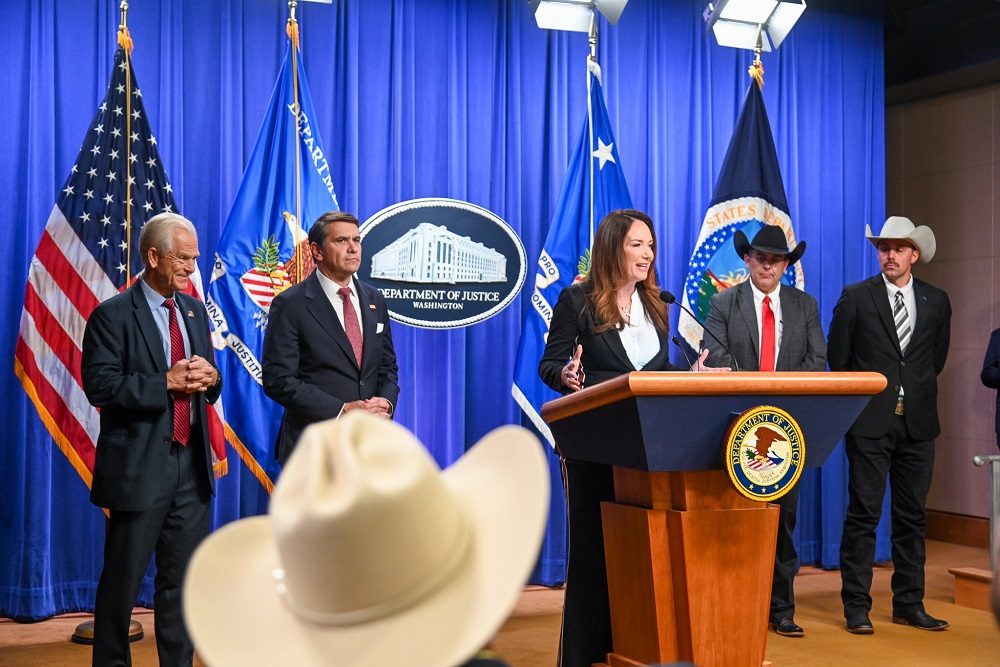
The Justice Department has opened a sweeping antitrust investigation into the U.S. beef industry, examining whether decades of consolidation among the nation’s largest meatpackers have distorted prices for both consumers and cattle producers, according to federal officials.
At a news conference Monday, Acting Attorney General Todd Blanche said investigators are scrutinizing whether dominant firms — including Tyson Foods, Cargill, JBS USA and National Beef Packing — have engaged in anti-competitive practices that contributed to rising beef prices. The four companies collectively control roughly 85 percent of the U.S. fed cattle market, a level of concentration long criticized by ranchers and farm groups.
“We will use every law enforcement tool available,” Blanche said, emphasizing the department’s willingness to pursue both civil and criminal violations. He declined to say whether the investigation was nearing a lawsuit.
The inquiry, which builds on concerns spanning multiple administrations, has already involved the review of more than 3 million documents and outreach to hundreds of industry participants, including ranchers, processors and buyers. Officials are examining potential violations such as price-fixing, bid-rigging and market allocation, while also encouraging whistleblowers to come forward with evidence.
Blanche highlighted the department’s fraud whistleblower rewards program, noting that individuals who provide information leading to penalties exceeding $1 million could receive between 15 and 30 percent of the recovered funds.
Agriculture Secretary Brooke Rollins framed the investigation as part of a broader effort to address structural challenges in the cattle industry, including historically tight supplies. The U.S. cattle herd stood at approximately 86.2 million head as of Jan. 1, the lowest level in decades, she said, while the number of ranchers has declined sharply — falling by more than 17 percent over the past 10 years.
“This has led to a frightening landscape for cattle ranchers,” Rollins said. “Industry consolidation reduces options for our ranchers looking to sell their cattle. It weakens their negotiating power, and it risks reliance upon a single buyer.”
Officials also raised concerns about foreign ownership within the sector. JBS, the world’s largest meatpacker, is headquartered in Brazil, and Marfrig Global Foods holds a controlling stake in National Beef. Rollins warned that such ownership structures could pose risks to U.S. food security, arguing that “food security is truly national security.”
Today, just four companies — JBS, Cargill, Tyson Foods, and National Beef — control roughly 85% of the cattle processing market. That level of concentration has surged from just 25% in 1977 to 71% by 1992, and now to an astonishing 85%.
Together, these companies operate through… pic.twitter.com/s4naYFcjt7
— Secretary Brooke Rollins (@SecRollins) May 4, 2026
White House trade adviser Peter Navarro pointed to a convergence of factors — including a shrinking cattle herd and high market concentration — as drivers of elevated beef prices, calling the current dynamics “a recipe” for inflation in the sector.
The investigation also follows a December 2025 executive order by President Trump directing federal agencies to examine price dynamics across the food supply chain, including potential manipulation in agricultural markets.
While the Justice Department has not indicated when the probe might conclude, officials said the inquiry could result in both civil enforcement actions and criminal charges. A settlement in a related case involving agricultural data firm Agri Stats is also expected soon, signaling a broader push by federal regulators to increase scrutiny of pricing practices in the livestock and meat industries.
For cattle producers, the outcome of the investigation could carry significant implications. Greater enforcement of antitrust laws, industry advocates say, may improve competition, expand market access and strengthen pricing power for ranchers who have long argued that consolidation has left them at a disadvantage.
CLICK BELOW to watch the press conference (beginning at 37:19):