

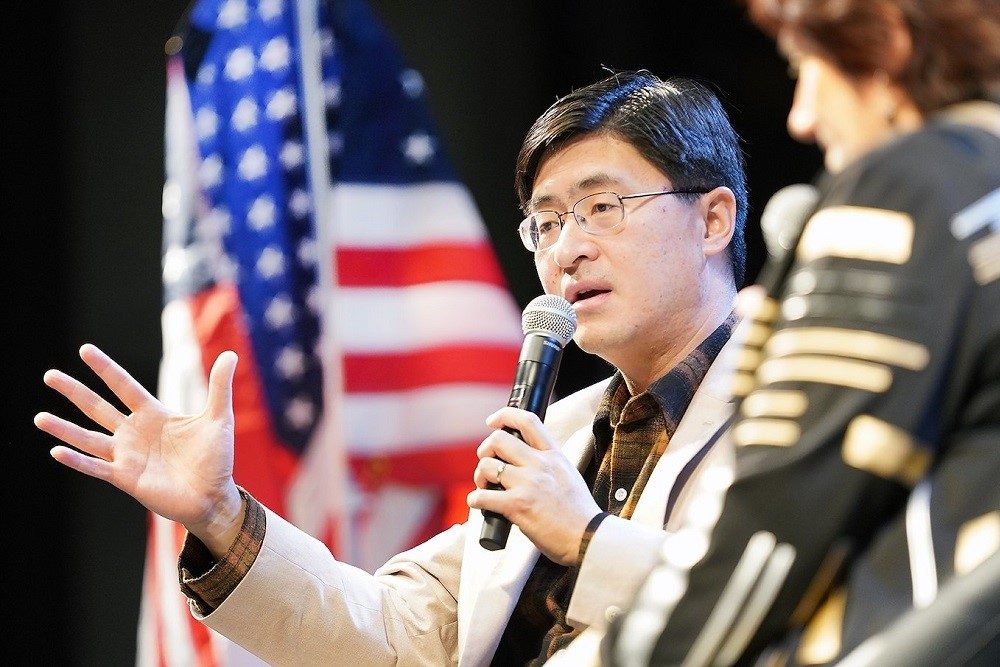
Mung Chiang, the president of Purdue University, will step down at the end of June to become the next president of Northwestern University, university officials announced Monday.
Chiang, who has served as Purdue’s president since January 2023, informed the university’s Board of Trustees that he had accepted the position at Northwestern, where he will begin July 1. His departure comes less than a year after Purdue extended his contract through 2031, underscoring both the speed of the leadership change and the demand for experienced university presidents during a turbulent period in higher education.
In a statement, trustees chair Gary Lehman credited Chiang with guiding Purdue through a period of growth and academic distinction amid mounting pressures facing universities nationwide.
“We are ever grateful for Mung’s leadership as Purdue continues to impact lives with outstanding teaching, research and engagement,” Lehman said, adding that the board will appoint an interim president in the coming weeks and launch a national search for a permanent successor.
Chiang, a former engineering dean and technology policy adviser, struck a reflective tone in announcing his departure.
“It has been an incredible honor and joy for me to work with the amazing board, colleagues, students and alumni here,” he said. “There truly is something special at Purdue — not just the projects and programs, but also the people.”
His tenure, though relatively brief, coincided with a period of expanding research investment and institutional ambition. Under his leadership, Purdue surpassed $1 billion in sponsored research expenditures, deepened industry partnerships and advanced initiatives spanning technology, health and business. He succeeded Mitch Daniels, the former Indiana governor who had led the university for a decade.
Before becoming president, Chiang served as Purdue’s executive vice president for strategic initiatives and dean of the College of Engineering. Prior to that, he was a professor at Princeton University and a founder of multiple startups focused on edge computing. He also served as a science and technology adviser during the Biden administration.
At Northwestern, Chiang will take over from Michael Schill, who stepped down last year. University officials there described Chiang as emerging from a global search that included input from hundreds of faculty, students, alumni and trustees.
Beyond campus leadership, Chiang had also become a familiar presence in Indiana’s agricultural community. Since his inaugural year as president, he attended the annual Purdue Ag Alumni Fish Fry each February, an event that draws thousands of farmers, policymakers and agribusiness leaders, reflecting Purdue’s deep ties to the state’s agricultural economy.
His departure leaves Purdue at a moment of both momentum and uncertainty, as universities nationwide confront shifting enrollment trends, financial pressures and political scrutiny. Trustees said the search for Chiang’s successor will begin shortly, with an interim leader expected to guide the institution through the transition.
For now, Chiang’s move represents both a personal milestone and a broader reshuffling among elite research universities — one that will be closely watched in West Lafayette and beyond.