


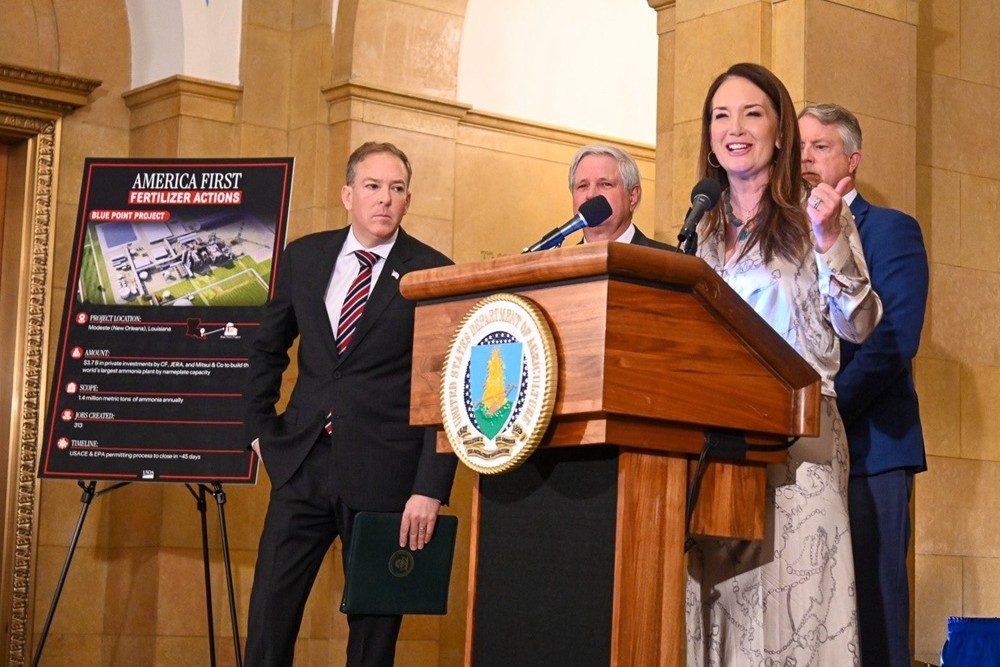
The Trump administration on Tuesday unveiled an expansive plan to accelerate domestic fertilizer production, casting the effort as both an economic imperative for American farmers and a strategic response to global instability that has disrupted agricultural supply chains.
Speaking at the U.S. Department of Agriculture headquarters, Agriculture Secretary Brooke Rollins stood alongside Energy Secretary Chris Wright and Environmental Protection Agency Administrator Lee Zeldin to outline what officials described as an “all-of-government” approach aimed at lowering farm input costs and reducing reliance on foreign suppliers. The initiative, they said, would combine revived federal grant programs, expedited permitting, and regulatory rollbacks to bring new fertilizer capacity online more quickly.
At the center of the effort is a reworking of the Fertilizer Production Expansion Program, a Biden-era initiative that administration officials argued had been slowed by climate-focused requirements. Rollins said the Department of Agriculture is reconnecting with previously approved projects that stalled under those standards, with the goal of restarting construction and boosting output.
Among the projects expected to move forward is an $80 million facility in Washington state designed to produce roughly 700,000 tons of hydrogen-based ammonia fertilizer annually. Administration officials estimate that revived and newly approved projects could unlock more than 2 million tons of additional domestic fertilizer capacity, enough to serve roughly 61,000 producers across 30 million acres of farmland.
For U.S. farmers, the stakes are immediate and tangible. Fertilizer remains one of the largest input costs in row-crop agriculture—often accounting for as much as 30 to 40 percent of total production expenses for crops such as corn and wheat. By increasing domestic supply, administration officials argue, the plan could ease price volatility that has plagued growers in recent years, particularly following supply disruptions tied to geopolitical tensions and trade disputes.
“Every tool in the toolkit has to be reviewed,” Rollins said, framing the effort as both a short-term response to global conflict and a longer-term restructuring of U.S. agricultural policy.
Energy policy is central to that vision. Wright emphasized that nitrogen fertilizer production relies heavily on natural gas, positioning expanded output as an extension of U.S. energy dominance. He said the administration is working to reverse restrictions on fossil fuel development that it believes have constrained domestic manufacturing capacity.
Regulatory changes are expected to play a decisive role. Zeldin said the EPA would accelerate permitting under the Clean Air Act and Clean Water Act for fertilizer and related infrastructure projects, a move intended to shorten timelines that can stretch for years. Administration officials pointed to a proposed ammonia facility in Louisiana—developed by CF Industries—as a test case, saying environmental approvals could be completed within weeks rather than years. The project, known as Blue Point, is projected to become the largest ammonia plant in the world once operational later this decade.
Supporters in Congress framed the initiative as a long-overdue correction to what they describe as an overreliance on imports. Sen. Roger Marshall (R-Kan.) said farmers have been squeezed by high input costs and limited supply options, noting that the United States continues to import significant volumes of fertilizer from countries including Russia and China.
Expanding domestic production, advocates say, could give farmers more predictable pricing, reduce exposure to international disruptions, and improve margins in an industry where profitability often hinges on narrow cost differences. Lower fertilizer costs can translate directly into more stable crop production, particularly in staple commodities that underpin both domestic food supply and export markets.
In Indiana, a separate but closely watched project underscores how the federal push could translate to regional development. Late in 2025, Wabash Valley Resources announced plans for a large-scale anhydrous ammonia facility in West Terre Haute, designed to convert petcoke and other feedstocks into low-carbon fertilizer. The project, still advancing through financing and permitting stages, has been pitched as a way to anchor domestic nitrogen production in the Midwest while supporting local agriculture with a closer, more reliable supply. Industry analysts say such facilities could reduce transportation costs for farmers across the Corn Belt and buffer them against global supply shocks, particularly if paired with streamlined federal approvals.
Officials acknowledged that further details are forthcoming. The Department of Transportation is expected to propose changes aimed at speeding fertilizer shipments nationwide, while the USDA plans to expand its internal economic monitoring of agricultural input markets.
For now, the administration is betting that a combination of faster permitting, revived investment, and energy policy shifts can deliver relief to farmers facing persistent cost pressures—and, in the process, reshape the balance between environmental regulation and agricultural production in the United States.
CLICK BELOW to watch the press conference: