

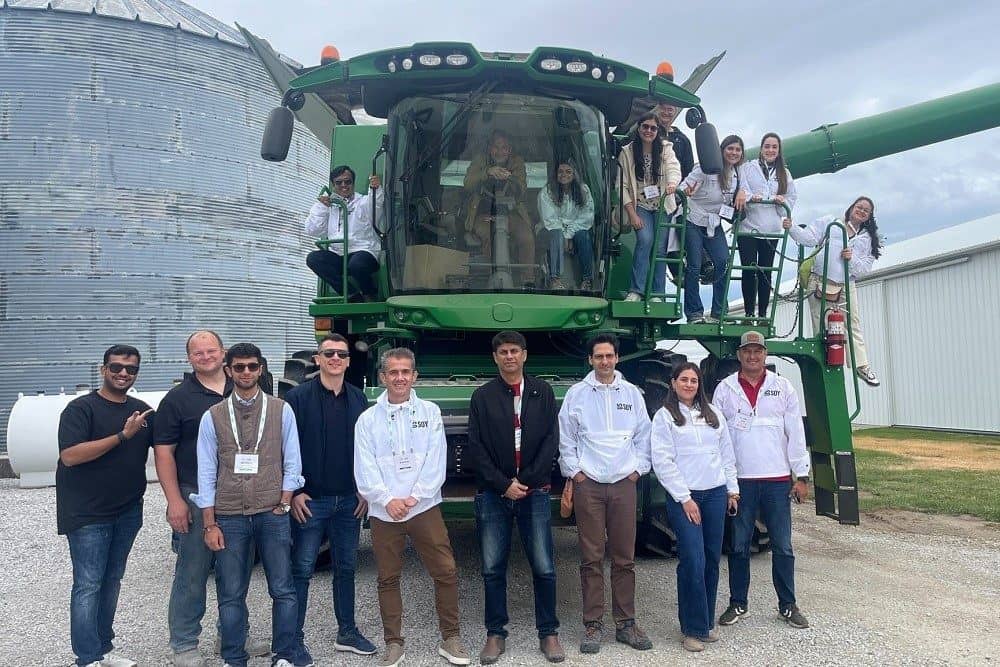
On a warm evening inside Gainbridge Fieldhouse, a group of international soybean buyers sampled food cooked in high-oleic soybean oil while watching the Indiana Fever play before a packed crowd. Earlier that same week, many of them had been standing in muddy farm fields, touring grain facilities and questioning Indiana farmers about everything from sustainability practices to supply chain reliability.
The visitors — 73 soybean industry representatives from 12 countries — were in Indiana as part of the Soybean Oil Masters program, an international outreach effort organized by the U.S. Soybean Export Council and the Indiana Soybean Alliance. The initiative reflects a broader push by American agriculture to strengthen trade relationships and secure overseas demand at a time when geopolitical tensions, shifting tariffs and intensifying global competition are reshaping commodity markets.
The delegation included importers, food manufacturers, refiners, chefs and agribusiness executives from countries including China, India, Japan, Mexico, Vietnam and South Korea. Organizers said the program is designed to immerse international buyers in the full U.S. soybean supply chain — from farms and research laboratories to processing plants and grocery shelves.
“For most attendees, this is the first time they have visited a U.S. soybean farm,” said Will McNair, director of soyfoods and oil and global team development for the U.S. Soybean Export Council. “I love seeing the excitement and curiosity as attendees learn directly from farmers, processors and other members of the supply chain.”
Indiana officials used the event to emphasize the state’s growing importance in global agriculture, particularly in the production of high-oleic soybeans, a specialty crop prized by food manufacturers for producing oils with longer frying stability and lower saturated fat levels.
“Indiana views itself as a global player in many industries,” Indiana state Rep. Danny Lopez, a Republican from Indianapolis, told participants during a ceremony last week. “When it comes to agriculture, and the soybean industry, Indiana is second to none.”
The effort comes as U.S. soybean producers seek to preserve and expand export markets amid continued uncertainty in global trade. China remains the world’s largest soybean importer, but American farmers have spent years attempting to diversify their customer base after trade disputes during President Donald Trump’s first administration disrupted exports and highlighted the risks of overreliance on a single market.
Indiana, the nation’s fourth-largest soybean-producing state, expects farmers to plant more than 5 million acres of soybeans this year, according to the U.S. Department of Agriculture. The crop generates more than $4 billion annually for the state economy.
The weeklong program brought international delegates to research sites at Purdue University, agribusiness facilities including ADM in Frankfort and Beck’s Hybrids, and several Indiana farms. Organizers also arranged two days of business-to-business meetings between exporters and international buyers at the Indiana Soybean Alliance headquarters in Indianapolis.
For many participants, the trip served as both a trade mission and a reassurance campaign.
Zhengyong Bai, who works with Clara Futura Holdings in China, said his company is increasingly focused on sourcing specialty soybeans that align with consumer demand for sustainability and traceability.
“I’m looking for high-oleic soybeans, non-GMO soybeans, and organic soybeans,” Bai said. “We’ve been meeting with some good suppliers.”
Farmers hosting the tours said the visits offer a rare opportunity to build personal relationships with overseas customers at a time when consumers and governments alike are demanding greater transparency in food production.
“Hosting a tour on my farm was a great experience,” said Allen Buchanan, an Indiana farmer and board member of the Indiana Soybean Alliance. “The people on the tour asked good, thoughtful questions, and I believe they learned a lot. This is about building trust between people — between soybean growers and soybean customers.”
Chris Eck, another Indiana farmer who hosted delegates, said face-to-face engagement remains essential in an increasingly competitive export environment.
“Trade visits are a chance to bring our global customers to the farm and show them the quality of the products we grow,” Eck said. “When we invest in bringing customers here to see how we grow our crops, they’re more likely to stay our customers for years to come.”
Since the program began in 2018, more than 1,500 soybean buyers from 20 countries have graduated from Soybean Oil Masters initiatives worldwide, according to organizers. South Korea, where the program originated, remains one of the largest importers of U.S. soybean oil and among the earliest adopters of high-oleic soybean products.
For Indiana farmers, the outreach effort is about more than promoting cooking oil. It is part of a larger strategy to maintain America’s foothold in an increasingly contested global agricultural marketplace — one where trade relationships can shift quickly and where commodity sales often depend as much on trust and diplomacy as they do on price.