


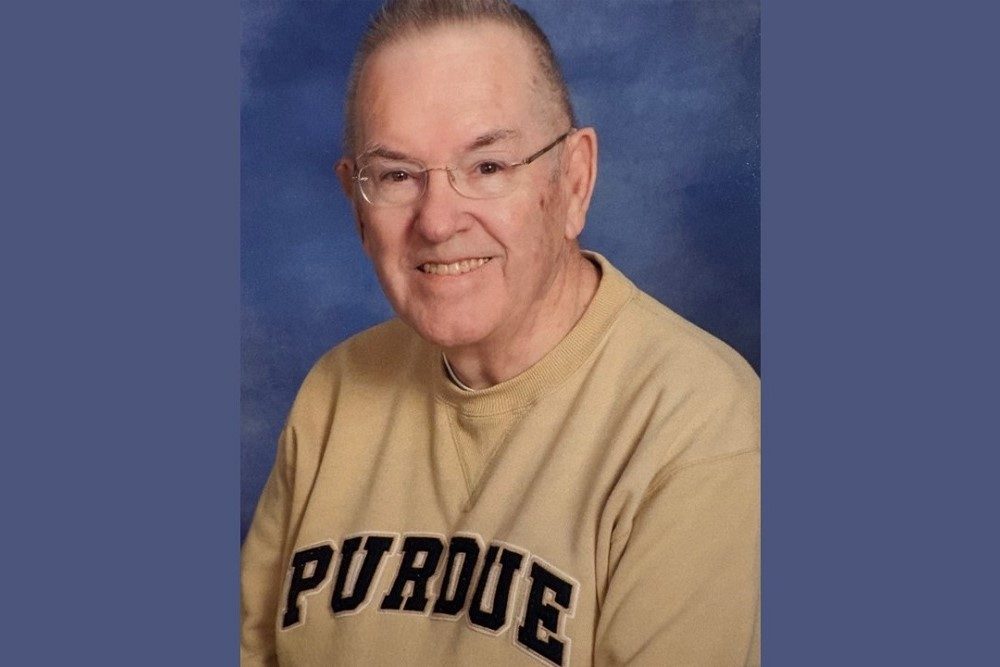
Robert “Bob” Eddleman, a farm boy from southern Indiana who rose to become one of the state’s most influential conservation leaders, helping shape agricultural policy, expand water-quality programs and inspire generations of young people through 4-H, died May 13. He was 88.
For more than six decades, Eddleman’s fingerprints could be found across Indiana’s landscape — from streambanks stabilized by conservation projects to schoolyards shaded by trees planted through a volunteer effort he helped launch after retirement. To colleagues, he was a tireless advocate for stewardship. To countless young people, he was a mentor. To many in Indiana agriculture, he became synonymous with conservation itself.
“Bob is a big reason Indiana has had such outstanding conservation efforts,” said Kent Yeager, president of the Indiana Barn Foundation and a former public policy adviser with the Indiana Farm Bureau. “I got to work directly with him when I was FSA state executive director in the mid-1990s. He was a great agricultural leader and a wonderful man.”
Eddleman was born Feb. 18, 1938, in Milltown, Ind., and grew up on a small family farm in the rolling hills of southern Indiana. The rural upbringing would define the course of his life.
As a boy, he immersed himself in 4-H and the Future Farmers of America, organizations that nurtured both his passion for agriculture and his emerging leadership abilities. By the time he arrived at Purdue University in the 1950s, classmates already viewed him as a rising figure in agricultural circles.
A 1958 profile published by The Purdue Agriculturist described Eddleman as a student whose leadership stood out even on a campus filled with future agricultural professionals. He served as president of Circle Pines Cooperative House, the Agricultural Council, the Poultry Club and the Agricultural Education Society. The profile predicted that agriculture needed leaders like Eddleman — individuals with both experience and a commitment to improving the profession.
The forecast proved remarkably accurate.
After earning a degree in agricultural education from Purdue, Eddleman joined the U.S. Department of Agriculture’s Soil Conservation Service, now known as the Natural Resources Conservation Service. What began as summer work during college evolved into a 42-year career in public service.
Along the way, he earned a master’s degree in public administration from the University of Oklahoma and steadily rose through the agency’s ranks. In 2000, he retired as Indiana’s state conservationist, one of the highest conservation leadership positions in the state.
His career coincided with a transformative period in American agriculture, as farmers grappled with soil erosion, water quality concerns and changing environmental expectations. Eddleman became a prominent advocate for balancing agricultural productivity with responsible stewardship of natural resources.
His influence extended beyond government service.
For more than 65 years, he was active in the Soil and Water Conservation Society, serving in numerous leadership roles, including president of the international organization in 2002. He received the society’s highest honor, the Fellow Award, in 1992.
Retirement, however, did little to slow him down.
As an Earth Team Volunteer, Eddleman contributed more than 1,500 volunteer hours annually supporting conservation initiatives. He served on the Hoosier Heartland Resource Conservation and Development Council and the Marion County Soil and Water Conservation District, while continuing to champion environmental projects across central Indiana.
Among his most ambitious efforts was the Plant A Million initiative, a campaign that mobilized volunteers and fundraising support to place more than a million trees in neighborhoods, schools, parks and along waterways. The project became one of the most successful tree-planting efforts in the nation.
Eddleman also emerged as a prolific educator. He delivered hundreds of presentations on tree care, invasive species management and conservation practices. He authored educational materials for homeowners and teachers and co-authored two widely used reference books, The Trees in Your Backyard and The Shrubs in Your Backyard.
In 2005, then-Gov. Mitch Daniels appointed Eddleman to the Indiana State Soil Conservation Board. He became chairman the following year and served for 16 years, helping oversee the state’s Clean Water Indiana program.
The honors accumulated throughout his career.
Purdue’s College of Agriculture recognized him as a Distinguished Alumnus in 1995. The Purdue Agriculture Alumni Association awarded him its Certificate of Distinction, honoring service to agriculture beyond the call of duty.
In 2000, Gov. Frank O’Bannon presented him with the Sagamore of the Wabash, one of Indiana’s highest civilian honors. That same year, Sen. Richard Lugar recognized Eddleman’s contributions in the Congressional Record.
Yet friends and family often measured his legacy less by titles and awards than by the lives he touched.
A lifelong believer in youth development, Eddleman remained deeply involved in 4-H long after his own decade as a member ended. He served as a 4-H leader for more than 50 years and encouraged each of his four daughters to participate in the program. Alongside his wife, Patricia “Pat” French Eddleman, he helped host generations of Wayne Township 4-H campers at Camp Woodsmoke.
Campers remembered him for many things, including a signature dish he called “Hoosier Crick Bank Taters.”
Others recalled the annual sea of geraniums that transformed the couple’s yard each spring. The flowers supported a Wayne Township 4-H fundraiser championed by Pat, while Bob quietly handled much of the logistical work behind the scenes. Their home became locally known as “the geranium house.”
His commitment to service extended beyond agriculture. Through years of supporting his daughters’ swimming careers, Eddleman became a respected official with Indiana Swimming, eventually earning the organization’s “Official of the Year” honor. He spent countless hours training officials and working meets throughout the state.
He also served for 45 years at St. Christopher Catholic Church in Indianapolis as a lector and Eucharistic minister.
Eddleman’s wife of 62 years died in 2023. Survivors include their four daughters, Mary Beth Brown, Susan Gregory, Julie Eddleman and Donna Sweeney; and eight grandchildren.
For a man who spent a lifetime encouraging others to leave the land better than they found it, his legacy remains visible across Indiana — in healthier waterways, stronger conservation programs, flourishing trees and generations of young people inspired to serve.
The Purdue student profile written nearly seven decades ago concluded that Eddleman would continue climbing the “ladder of success.”
Instead, those who knew him best might argue that he spent his life building ladders for others.
Gary Truitt, founder of Hoosier Ag Today, wrote this tribute to Bob Eddleman upon his passing:
“There are people who advocate for agriculture and conservation, and then there are people who just quietly get the job done. Bob Eddleman was one of the latter. As State Conservationist, he helped lay the groundwork for the Indiana Conservation Partnership which lets federal, state, and local agencies work together to improve soil and water conservation. This partnership has served as a model for other states and has put our state at the forefront of conservation efforts.“When there was a need to educate the public about the importance of soil and water conservation, Bob literally picked up a shovel and helped build the Pathway to Water Quality at the State Fair that, each year, educated thousands on clean water and soil erosion. As member of the board of the Center for Agriculture, Science, and Heritage (CASH), he worked to protect the heritage of Indiana agriculture while promoting the importance of farming’s future.“A man with a love for trees and a loathing for invasive species and plants, he initiated the Plant A Million project. A 50+ year 4-H volunteer, he impacted the lives and livelihoods of thousands of young people, many of whom are leaders in agriculture and their communities today. Bob is gone, but our world still has the imprint of his work from groves of native trees, to grass filter strips, to cover crops on no-tilled farm fields. His legacy will last for generations.”