

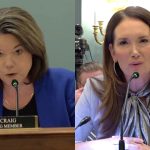
The nation’s worsening farm economy took center stage on Capitol Hill on Thursday as a House Agriculture Committee hearing descended into a sharp and personal confrontation between U.S. Agriculture Secretary Brooke Rollins and Rep. Angie Craig, the committee’s top Democrat.
The hearing, intended as an oversight review of the U.S. Department of Agriculture, quickly evolved into a broader debate over whether the Trump administration’s economic and trade policies are helping or hurting American farmers at a time when many producers are grappling with low commodity prices, elevated production costs and tightening profit margins.
Craig, a Minnesota Democrat who serves as ranking member of the House Agriculture Committee, repeatedly pressed Rollins on farm income losses, fertilizer affordability, diesel costs and the administration’s handling of agricultural trade.
The most contentious exchanges came as Craig challenged the secretary on the financial condition of U.S. farmers.
“Do you know how much money farmers lost last year? It was $28 billion. You’re the Secretary of Agriculture. $28 billion,” Craig said.
Rollins disputed the characterization.
“Well, it depends how you calculate that, because I don’t think you’re taking into account all the crop protection, all the insurance, all of the, the uh, different programs that went through to support our farmers—”
Craig and Rollins repeatedly talked over one another throughout the hearing, with tensions rising as the discussion shifted from farm profitability to input costs.
At one point, Craig interrupted the secretary while questioning her about economic conditions facing producers.
“Madam Secretary, do you know what percent— I’m reclaiming my time.”
Rollins responded sharply.
“Okay, I just ask you not to be so rude.”
Later, the secretary again pushed back against Craig’s questioning style.
“Can we have a conversation without being so rude? I just asked you not to be so rude. I’d really like to have a legitimate conversation.”
Craig argued that farmers are increasingly struggling with the cost of essential inputs and cited survey data she said showed many producers could no longer afford adequate fertilizer purchases.
“Do you know what percentage of farmers now say they can’t afford fertilizer for this year as a result of the president’s war in Iran? Seventy percent is the answer.”
Rollins challenged the accuracy of those figures, saying they did not align with available government data.
The hearing became even more heated when Craig questioned the secretary about diesel fuel prices.
“What’s the national average of farm diesel right now?” Craig asked.
“The national average of farm diesel… well diesel has increased because of the Iranian conflict,” Rollins replied.
Craig pressed for a specific number.
“How much—how much was it? How much is it right now?”
Rollins responded by criticizing economic conditions inherited from the previous administration.
“Well, before the Iranian conflict, it had gone way up under the last—all inputs under the last administration increased about 40%. That’s what we inherited, and it all was coming…”
Craig immediately interrupted.
“Re-reclaiming my time. Madam Secretary, Joe Biden is no longer the president of the United States. Mr. Trump is. Your party controls Congress. You own these numbers at this point in time.”
The exchange underscored a broader political battle over responsibility for the farm economy. Republicans have argued that inflationary pressures and rising production costs began during the Biden administration, while Democrats contend that the Trump administration now bears responsibility for worsening conditions, particularly as farmers face uncertainty surrounding tariffs and export markets.
Throughout the hearing, Rollins defended the administration’s approach, pointing to federal farm safety-net programs, crop insurance protections and other forms of assistance available to producers. Craig countered that many farmers would require less government support if export opportunities were stronger and production costs were lower.
The disagreement culminated in a blistering closing statement from Craig, who accused the administration of refusing to acknowledge the financial challenges facing rural America.
“We have heard a lot from the secretary today. A lot of excuses. A lot of looking in the rearview mirror after one and a half years of total Republican leadership in Washington.
“The lack of accountability or ownership of this administration’s failures is truly stunning. And worse – we are going to be right back where we are today in a year if the administration continues down the same path.
“Madam Secretary, I have farmers coming to Capitol Hill who, in the privacy of our meetings, tell me that they wish we had a Secretary of Agriculture who would just be straight with them and acknowledge the reality on the ground. They see the same song and dance that everyone got here today, but unlike most people in this room, they then turn to their ledgers, their disappearing margins and their increasing debts and the picture they see does not match the rosy picture painted by the secretary.
“They are being crushed by tariffs and high costs. Families in Minnesota and across the country are paying more for groceries each month, and they’re starting to skip meals and buy less because Trump’s policies are eating away at their paychecks.
“We have before us an agriculture secretary who is giving a wonderful performance for a reality TV president – a performance that is scripted, rehearsed and disingenuous. A performance that falls flat, because it is not based on anything real, but based on what she thinks the president wants to hear.
“All Americans – including farmers and working families – just want the Trump administration to be straight with them and focus on policies that help alleviate their financial pain – not make it worse.”
The confrontation between Rollins, representing the Trump administration and congressional Republicans, and Craig, the committee’s top Democrat, offered a vivid illustration of the widening partisan divide over farm policy at a moment when Congress is already struggling to build consensus on agriculture’s most important legislation.
Republicans have largely focused on expanding crop insurance protections, strengthening commodity programs and defending the administration’s trade and economic agenda. Democrats, meanwhile, have increasingly highlighted the financial pressures facing farmers from rising input costs, market uncertainty and tariff-related disruptions, while also defending nutrition programs that make up a significant portion of federal farm spending. The sharp disagreements on display during Thursday’s hearing underscored how far apart the two parties remain on both the diagnosis of the farm economy and the solutions needed to address it.
Those divisions could have consequences far beyond a single committee hearing. Congress is now years overdue in passing a new Farm Bill, relying instead on a series of temporary extensions to keep existing programs in place. While bipartisan cooperation has historically been a hallmark of farm legislation, the increasingly combative tone surrounding agricultural policy raises questions about whether lawmakers can assemble the broad coalition needed to move a comprehensive bill through Congress.
The challenge may be particularly acute in the Senate, where most major legislation requires 60 votes to overcome procedural hurdles. If lawmakers cannot bridge fundamental disagreements over farm safety-net programs, trade policy, conservation spending and nutrition assistance, the path toward a long-term Farm Bill could remain uncertain.
For farmers watching from across the Midwest and beyond, Thursday’s hearing served as more than a contentious exchange between two political rivals. It offered a glimpse into the partisan gridlock that continues to complicate efforts to deliver the long-term policy certainty many producers say they need as they navigate one of the most financially challenging periods in recent years.
CLICK BELOW for Hoosier Ag Today’s radio news report: