

The explosive growth of artificial intelligence is rapidly reshaping the American landscape, moving out of urban tech hubs and squarely into the nation’s farmland. But as tech giants scout thousands of acres of rural land to build the massive data centers required to power the digital economy, a new backlash is brewing from the communities expected to host them.
According to a new study from the Gardner Food and Agricultural Policy Survey, rural Americans are deeply concerned about the hidden costs of the AI boom, harboring intense anxieties over skyrocketing electricity bills, depleted water supplies, and the loss of prime agricultural land.
The research, published June 25, 2026, was co-authored by Dr. Brenna Ellison, a Professor of Agribusiness Management and the Undergraduate Programs Coordinator in the Department of Agricultural Economics at Purdue University, alongside researchers from the University of Illinois.
The findings highlight a widening cultural and economic rift between the tech industry’s rapid expansion and the rural towns left to manage the physical strain on their infrastructure.
“Artificial Intelligence has the potential to reshape our economy and workforce,” the authors note in the study. “Data centers serve as the physical infrastructure for AI, but they come with notable costs and unknowns.”
A Shift to the Countryside
While 87 percent of existing data centers currently operate in urban areas, the geography of the internet is shifting. The study points to data from the Pew Research Center showing that 67 percent of planned data center facilities are slated for rural communities. Shockingly, nearly 40 percent of these massive complexes are destined for counties that currently do not host a single one.
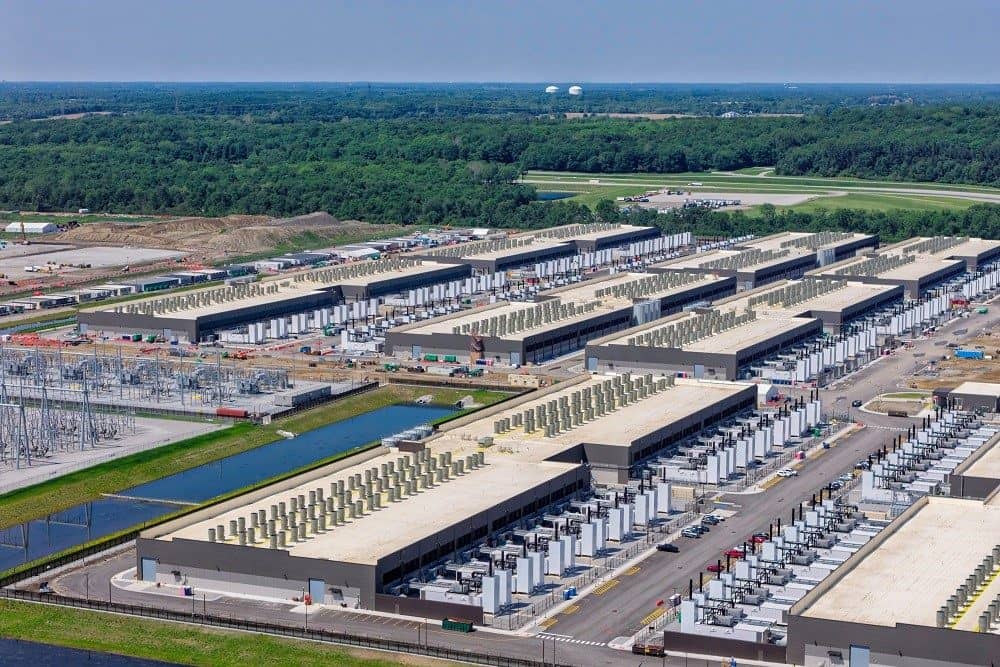
Modern data centers built to support AI are resource-intensive behemoths. They require between 500 and 800 acres of land—often swallowing up active farms—and demand staggering amounts of electricity to run servers and millions of gallons of water to keep liquid-cooling systems from overheating.
By 2030, energy requirements for data centers are projected to more than double in Illinois and triple across Indiana, Michigan, Minnesota, and Wisconsin.
Power Bills and Farmland
The survey, which evaluated approximately 1,000 U.S. adults, asked respondents to rank their worries on a scale of 1 (not at all worried) to 7 (extremely worried). Across the board, concerns over data centers consistently tracked above the midpoint.
However, the anxiety was most acute among rural residents, particularly when it came to their wallets.
Rural respondents registered the highest level of worry regarding surging energy costs, averaging 5.41 out of 7. More than half of all rural residents surveyed classified themselves as “very worried” that data centers would drive up their electricity bills—outpacing urban residents by 11 percentage points.
How these energy costs hit consumers depends heavily on local regulation. In states with regulated utilities, power companies can build massive grid upgrades specifically to serve data centers and legally pass those multi-million-dollar costs onto regular ratepayers. In partially deregulated markets, the massive load can skew wholesale energy prices upward.
Loss of farmland was another major flashpoint. Rural and urban residents alike expressed deep concern over agricultural land being paved over for server farms, while urban residents showed the highest sensitivity toward water overuse, with 44.5 percent reporting they were “very worried” about water security.
An “Asymmetric” Battle for Small Towns
For decades, rural towns have courted industrial development to boost dwindling tax bases. Data centers are undeniably capital-intensive projects that can generate millions in local property tax revenue. But the study warns that the economic windfall is often a mirage.
While construction brings a temporary surge of manual labor, the long-term employment benefits are “often overstated,” according to the researchers. Once operational, a data center requires only a modest staff for maintenance and security. Furthermore, while they can drive up local home values—a benefit for property owners—they frequently price out local renters and prospective buyers.
The study paints a cautionary tale of small-town governments facing off against multi-billion-dollar tech conglomerates.
Large tech companies arrive in rural communities flanked by specialized lawyers, engineers, and financial analysts. Conversely, small agricultural towns often rely on volunteer mayors, part-time elected officials, and severely constrained budgets.
“In these instances, there is often an asymmetric relationship,” the authors warn, noting that small towns are frequently unequipped to negotiate effectively or recognize the long-term trade-offs involving noise pollution, air quality, and infrastructure strain.
To level the playing field, the researchers urge local leaders to look past the glitzy economic pitches, perform strict due diligence on developers, and utilize community guidelines—such as those published by Penn State Extension—to demand hard answers on water usage, power grid strain, and actual job creation before breaking ground.
CLICK HERE to read the full study.