

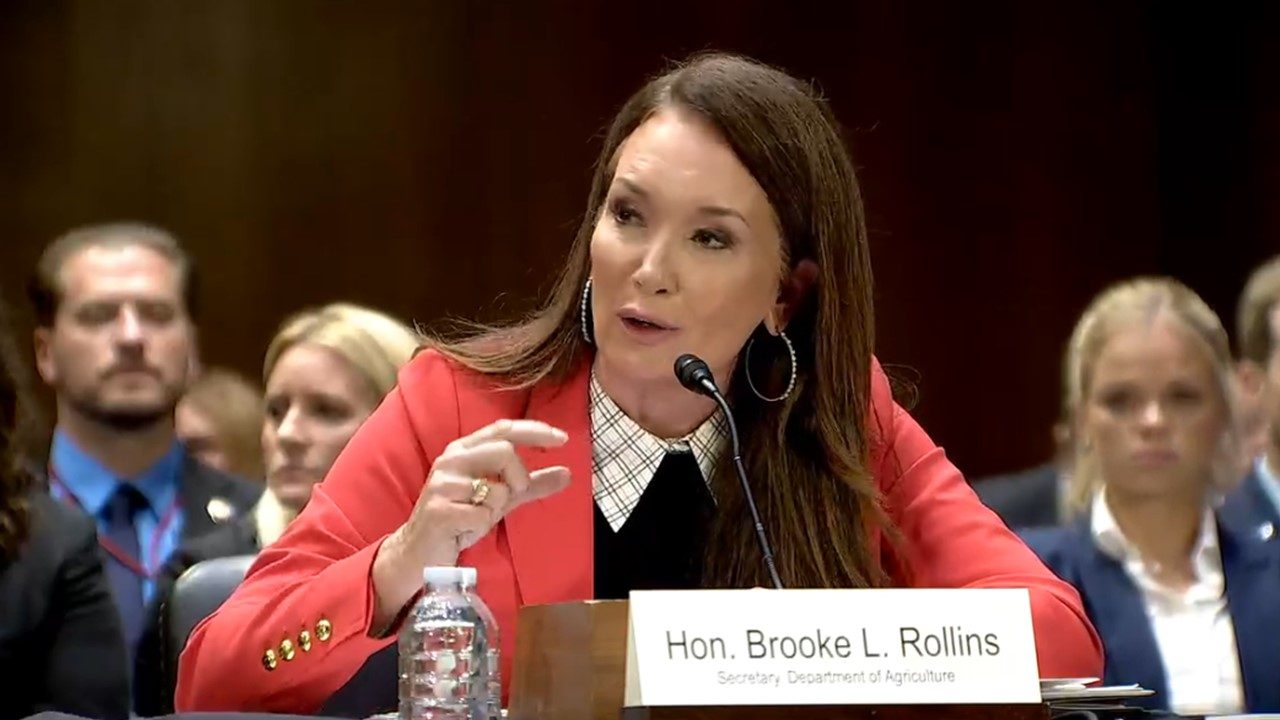
U.S. Agriculture Secretary Brooke Rollins addressed a tense Senate Appropriations Committee on Tuesday, delivering a blunt assessment of the American farm economy: producers are weathering a “unique storm” of high input costs, soft commodity prices, and market volatility that demands immediate federal action.
Rollins joined defense leaders on Capitol Hill to push for the administration’s sweeping $87.6 billion supplemental spending package. Within that request sits an $11.1 billion agricultural lifeline—comprising $10 billion in temporary economic assistance for row crop and specialty crop producers and $1.1 billion for regional disaster relief, including devastating winter freezes.
For farmers across the Midwest and the heartland, the message from Washington is that this package is designed as a critical bridge. It aims to keep operations solvent while long-term policy shifts, trade expansions, and regulatory reforms take root.
“Our producers are facing a unique storm of high input costs and market uncertainty,” Rollins told senators during the hearing, presided over by Chair Susan Collins (R-Maine). “This emergency supplemental request delivers targeted assistance directly where it’s needed most, ensuring American agriculture remains resilient while long-term farm policy takes shape.”
A Bridge, Not a Permanent Handout
As lawmakers sparred over the broader components of the supplemental package—including defense funding and its relationship to ongoing international conflicts—Rollins maintained that the agricultural portion is squarely focused on domestic survival and economic restructuring.
The administration’s proposal follows $40 billion in emergency and disaster assistance delivered by the USDA over the past two years, responding to natural disasters and declining farm income. However, Rollins emphasized that existing permanent programs were not built to absorb the compounding pressures of 2026, which include widespread drought affecting nearly 47% of the country and severe winter freeze losses spanning from Florida to the Pacific Northwest.
According to USDA data, secretarial disaster designations have climbed from 1,012 counties in 2025 to 1,152 counties so far in 2026.
Despite the urgent need for cash flow, Rollins pushed back against the notion of long-term government dependence, emphasizing that farmers ultimately want fair markets rather than endless checks.
“As I travel through the countryside, I have heard loud and clear—our farmers and ranchers want fair markets, not endless handouts,” Rollins stated in her formal testimony. “Our aid programs serve as a limited but critical bridge to the improvements we have made through the Working Families Tax Cuts Act, the massive new trade markets opening up, and the decrease in input costs.”
Pointing Fingers at Agribusiness Consolidation
A major flashpoint during Tuesday’s hearing was the root cause of the financial squeeze hitting producers. While several lawmakers pointed to global trade disruptions and supply chain shocks stemming from geopolitical conflicts and the closure of the Strait of Hormuz, Rollins placed a significant share of the blame closer to home.
The secretary argued that while farmers struggle with razor-thin margins, major input suppliers—spanning equipment manufacturers, seed companies, and fertilizer giants—have continued to post record profits.
“We are doing these supplementals and these bridge payments, which we have to do for these farmers to survive,” Rollins testified. “But what we’re seeing is just survival, and we’re seeing a lot of the input companies… make record profit. So, we’ve got to be able to dig into that as well.”
Senators on both sides of the aisle acknowledged the severe economic realities facing rural communities. Mississippi Republican Senator Cindy Hyde-Smith stressed that immediate market assistance is non-negotiable if the nation wants the next generation to stay on the land.
“If we want the next generation to stay on the land, Congress, we’re going to have to take this opportunity to provide this critical market assistance for our farmers,” Hyde-Smith said.
Food Security is National Security
Framing the debate within the broader context of national stability, Rollins and supporting senators underscored that domestic agricultural production is inextricably linked to national defense and energy independence.
By pairing the emergency package with expanded domestic energy strategies—such as pushing for higher ethanol blends like E15 to boost corn demand—lawmakers argued that strengthening the farm safety net is a matter of national security.
“Protecting America’s food supply, energy supply, and national defense are not separate priorities—they reinforce one another,” lawmakers noted during committee discussions.
As the Senate Appropriations Committee weighs the final figures of the supplemental request—alongside a parallel $12 billion agricultural aid effort moving through the House via reconciliation—the pressure is on Washington to deliver results before the next growing season.
For producers caught between high overhead and shifting global markets, Secretary Rollins’ message to Capitol Hill was unmistakable: passing the package buys the nation the security it needs, and it buys America’s farmers time to survive.