


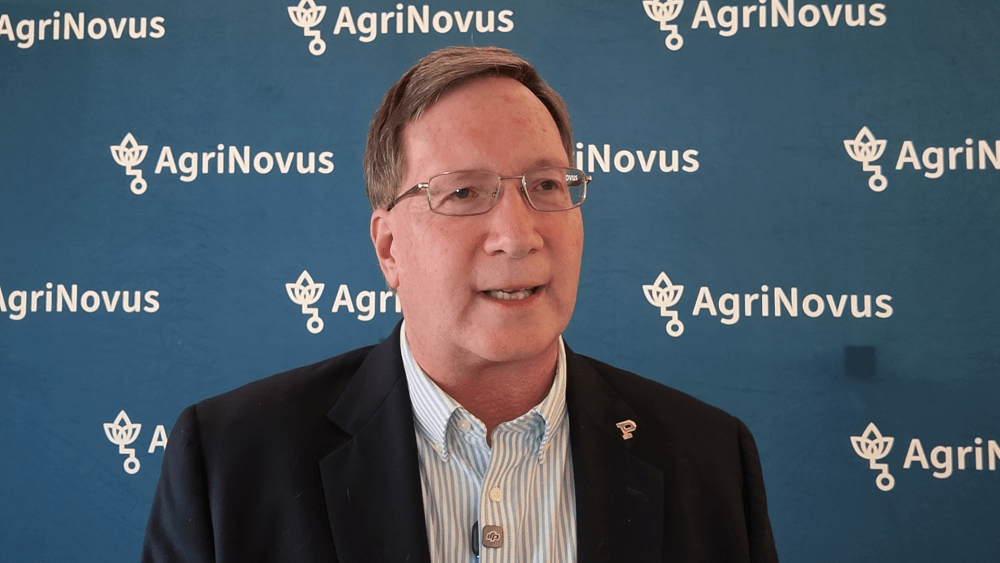
Artificial intelligence in agriculture is a hot topic right now, whether applied directly in the field or in the farm office. AI took center stage Wednesday evening at AgriNovus Indiana’s Quadrant event in Indianapolis, where experts discussed the practical realities of emerging technology.
Dennis Buckmaster, a panelist at the event and a professor of Agricultural and Biological Engineering at Purdue University who also serves as the Dean’s Fellow for Digital Ag, shared a popular social media meme that caught his eye.
“I want AI to do my laundry and dishes so that I can do writing, not do writing so that I can do laundry and dishes,” Buckmaster said. Adapting the concept for agriculture, he added: “My ag corollary was: I want AI to do my business and taxes so that I can drive the tractor, not drive the tractor so that I can do the business and taxes.”
While that sounds ideal in theory, Buckmaster noted that ag economists warn against trusting AI to handle farm taxes completely. However, producers learned during the panel that AI can still serve as a valuable tool to jumpstart the process so an accountant can complete the work much faster. Rather than feeding sensitive farm data directly into AI, growers can use it to figure out how to best structure records so they are more readily usable for their accountant.
Buckmaster stressed the importance of getting farm operations “AI-ready.” The focus is not on giving data away to AI, but learning how to ask the right questions to help operational decisions, such as whether a specific practice in corn production generated higher returns than an alternative approach.
Posing those questions effectively requires strong recordkeeping and what Buckmaster calls “contextual metadata.” That includes details such as planting dates, seed varieties, fertilization, weather conditions throughout the season, machinery calibration, and labor requirements. And it requires making them digital.
For farmers looking to make their operations AI-ready, Purdue University has resources available. Find more information on the Purdue Institute for Digital and Advanced Ag Systems website.