


President Donald Trump is doubling down on his support for data centers as communities across the country — including those across Indiana — push back against where and how quickly the massive facilities are being built.
In a Monday morning social media post, Trump delivered a blunt message to communities resisting the data-center boom: embrace them or risk falling behind.
“The only reason that communities throughout the U.S.A. should not want Data Centers is if they want to end up being backwards and poor,” Trump wrote. “If they want to be successful and rich, with far lower taxes and jobs all over the place, let Data Reign.”
Trump’s comments come as opposition to data centers has become an increasingly visible political issue across the country — and in Indiana, where dozens of projects have been proposed in communities from northern Indiana to the Indianapolis region.
For farmers and rural residents, the debate is about far more than artificial intelligence. It is about farmland, water, electricity, property taxes., infrastructure and ultimately, who gets to decide what happens to the land and resources surrounding their communities.
Indiana already has more than 70 data centers in operation, with dozens more proposed. The growth has put the state near the center of the Midwest’s data-center boom and has fueled a contentious debate over whether the economic benefits justify the demands these facilities place on rural communities.
Trump sees the stakes differently.
The president has repeatedly argued that the United States must move aggressively to expand artificial intelligence infrastructure and maintain its competitive edge over China. In Monday’s post, he warned that communities rejecting data centers could jeopardize that effort.
“If we kill the Golden Goose, you will only have yourselves to blame,” Trump wrote. “China could not be happier with this anti Data Center movement.”
But the backlash isn’t limited to one political party — or one part of the country.
A national Economist/YouGov survey conducted earlier this month found 61% of Americans opposed construction of a data center in their community, including 47% of Republicans. More than half of Americans also disagreed with Trump’s assessment that communities should welcome data centers as a path to greater prosperity.
And Indiana has seen firsthand why the issue has become so contentious.
A massive footprint on farmland
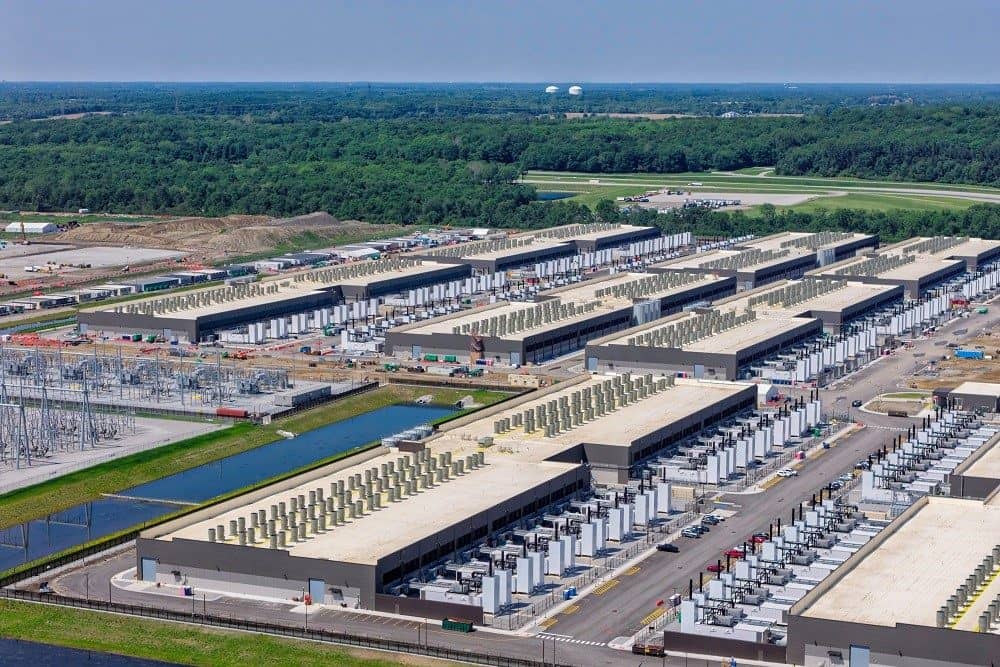
One of the state’s most prominent projects is Amazon’s massive AI data center near New Carlisle in St. Joseph County.
The $11 billion facility, which opened last year, occupies roughly 1,200 acres that was farmland only a few years ago. Amazon also has plans for another $15 billion data center in Hobart.
Those projects represent billions of dollars in investment, but their sheer scale illustrates the challenge facing Indiana communities.
Data centers can require enormous amounts of electricity and water. They can also consume hundreds or thousands of acres while employing comparatively few workers once construction is complete.
For rural Indiana, that creates an uncomfortable question:
How much farmland, water and electricity should communities be willing to dedicate to an industry that is expected to play a central role in the nation’s AI future?
Vice President J.D. Vance acknowledged Monday that the concerns driving opposition are real.
“I think probably 99% of the backlash to data centers has come in areas where building a data center means higher utility and higher electricity for the people on the ground,” Vance said.
His solution?
Companies building the facilities should also build the power generation necessary to support them.
“If you build a data center, you should be putting power back into the grid, not taking it out,” Vance said.
That argument closely echoes concerns already raised by Indiana Gov. Mike Braun.
Braun: Hyperscalers must pay
When Hoosier Ag Today spoke with Braun earlier this year, he acknowledged both sides of the data-center debate.
“It’s a real issue, but it can be a big economic benefit if we get it right,” Braun said.
But getting it right, Braun said, means ensuring existing Indiana residents and businesses aren’t forced to shoulder the infrastructure costs associated with massive new electrical demand.
“Data centers are only going to work if the hyperscalers pay for every penny of it,” Braun said. “The companies that want them are the richest in the country. Whether they’re in front of the meter or behind it, [their electrical usage] cannot impact current families and businesses.”
Electricity isn’t the only concern.
Farmers and rural residents have also raised questions about how much water data centers will consume to cool the thousands of servers operating inside their facilities.
In agricultural areas, where water availability can directly affect crop production, the concern is particularly significant.
Braun said new projects should incorporate water-recycling infrastructure rather than continually drawing fresh water from Indiana’s resources.
“That eliminated probably a bigger issue — that we don’t have water evenly across the state,” Braun said. “We’re a state that’s blessed with more of it than most other places. But, we really don’t have much to spare.”
Over time, Braun said, water used for cooling should be recycled rather than treated as a continuously available resource.
Local control at the center of Indiana debate
Perhaps most significantly, Braun said he believes Indiana’s communities should have the final say over whether a data center makes sense for them.
“I think you’re going to see that the real pros and cons will be fleshed out, and it will be right for some places and not for others,” Braun said. “But, that should be up to individual counties to see what makes sense for them.”
That position puts Indiana’s debate in a somewhat different place than Trump’s national argument.
Trump is warning communities that opposing data centers could mean missing out on economic growth and weakening America’s position against China.
Indiana communities, meanwhile, are asking whether the economic benefits can be achieved without shifting the costs onto existing residents, businesses, farmers and taxpayers.
Braun believes both objectives can be pursued.
“[Data centers are] driving a lot of the economic growth across the country, and it is associated with AI,” Braun said. “If we don’t stay ahead of China on it, I think we’ll regret that in a broader more strategic way.”
That may be the common ground in an increasingly divisive debate.
Few policymakers dispute the strategic importance of artificial intelligence or the economic opportunity surrounding it. The disagreement is over who pays for that opportunity — and where the infrastructure should go.
For Indiana agriculture, that distinction matters.
Every proposed data center represents more than servers and artificial intelligence. It can mean farmland removed from production, new demands on electrical infrastructure and questions about water supplies that farmers depend on.
And as Trump’s latest comments make clear, the pressure to build isn’t going away.
The question facing Indiana communities is whether they can harness the economic power of the AI boom without sacrificing the land, resources and local control that helped build the state’s agricultural economy in the first place.
For now, the answer remains decidedly unsettled.