

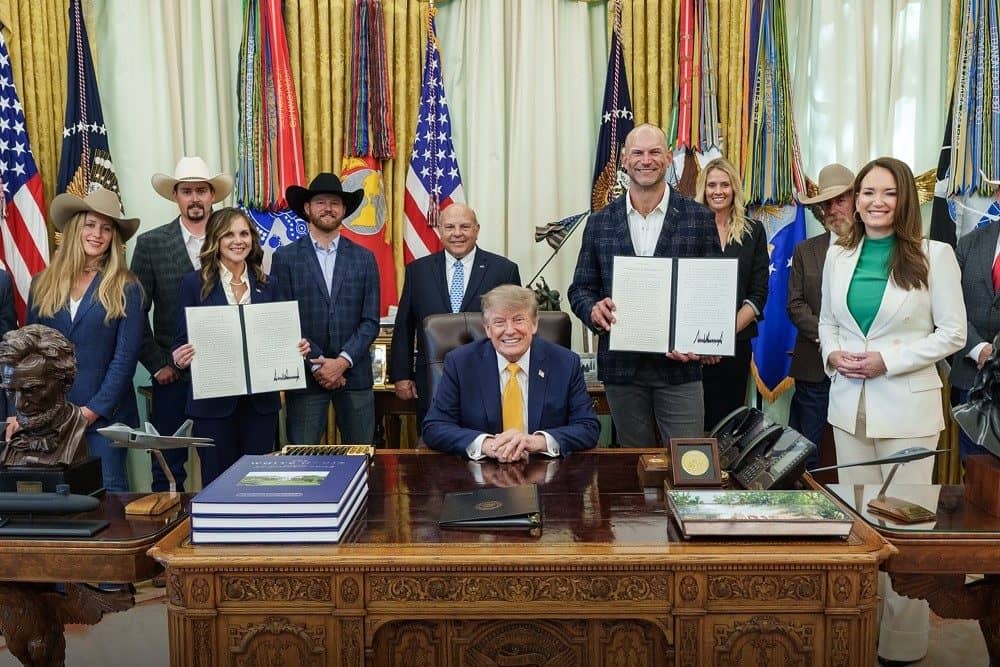
President Donald Trump signed two executive orders Friday aimed at reshaping the U.S. livestock and meat-processing industry—strengthening enforcement of the Packers and Stockyards Act, expanding opportunities for small and regional processors, easing barriers to interstate meat sales and directing a review of mandatory country-of-origin labeling for beef.
The moves come at a pivotal moment for cattle producers. The U.S. cattle herd is at its smallest level in roughly 75 years, beef demand remains strong and ranchers are working to rebuild their herds. At the same time, the administration’s recent decision to expand access to imported beef has triggered sharp criticism from cattle organizations concerned that cheaper foreign beef could weaken cattle prices and discourage herd expansion.
The White House says the latest orders are designed to attack a different piece of the problem: concentration in the meatpacking industry and a lack of processing options for producers.
The administration points to a dramatic increase in concentration among the nation’s largest beef packers. According to the White House, the four largest beef packers accounted for 36% of purchases of steers and heifers more than four decades ago. Today, that figure has climbed to 85%.
The executive order directs USDA to prioritize investigations into potential violations of the Packers and Stockyards Act, increase investigative resources and coordinate with the Department of Justice on potential antitrust enforcement.
USDA also has 60 days to report to the president on current enforcement actions, resource needs and a plan for heightened enforcement during the coming year.
Opening more doors for small processors
For many livestock producers, however, the most immediate impact could come from the administration’s push to expand local and regional processing.
The order directs USDA to streamline participation in programs that allow state-inspected meat to enter interstate commerce, including the Cooperative Interstate Shipment and Talmadge-Aiken programs.
It also calls for technical assistance and training for small and very small processors, a centralized USDA resource to help producers navigate licensing and inspection requirements, and modernization of meat inspection procedures.
The administration says the goal is to remove regulatory requirements that do not advance essential food-safety objectives while maintaining food-safety standards.
The order also calls for a new “Strengthening Processing for U.S. Ranchers” guaranteed loan program designed to help small and regional processors stay in business, expand and increase the variety of animal proteins they process.
That could prove significant in a cattle industry where access to a nearby processor can determine whether a producer has another marketing option—or remains dependent on a handful of large packers.
COOL returns to the table
Country-of-origin labeling is also back in the spotlight.
A second executive order directs USDA, working with the U.S. Trade Representative, to review existing legal authority for mandatory country-of-origin labeling on beef and conduct an economic analysis of its potential impacts.
The administration could pursue regulatory changes where legally permissible or develop legislative recommendations for Congress.
Trump said during Friday’s signing ceremony that mandatory labeling would require congressional involvement.
American Farm Bureau Federation President Zippy Duvall said he discussed the issue directly with Trump following the White House event.
“America’s beef producers were the focus of today’s meeting at the White House. Among the topics covered under the executive orders is a call for an interagency review of mandatory country of origin labeling for beef. Farm Bureau policy supports voluntary Country of Origin Labeling (COOL) that conforms with COOL parameters and meets World Trade Organization requirements.”
Duvall also welcomed the administration’s efforts to expand processing opportunities.
“We appreciate the president’s support for small processors by exploring new opportunities and expanded inspection access. Creating competition benefits both ranchers and consumers.”
But imports remain a major fault line
The processing changes arrive as ranchers remain deeply concerned about another White House policy: increasing beef imports in an effort to bring down consumer prices.
On Aug. 26, Trump increased the 2026 tariff-rate quota for certain lean beef trimmings by 300,000 metric tons, with the additional volume being released in three 100,000-metric-ton tranches. The first tranche opened Sept. 1.
The National Cattlemen’s Beef Association sharply criticized the move when it was first announced.
NCBA CEO Colin Woodall said Aug. 21:
“NCBA is disappointed by the President’s statement. While America’s cattle producers share the goal of keeping groceries affordable for consumers, flooding the market with government-subsidized, below-market beef is not the way to rebuild the American cattle herd. Cattle markets have already turned sharply lower this morning, to the detriment of farmers and ranchers. This is a critical time of year for cattle producers, as we approach the season where they are making decisions regarding their herds. Cattle farmers and ranchers are responding to strong market signals and historically high demand, and we are already working to rebuild after years of ongoing drought, high input costs and other challenges that have reduced U.S. cattle numbers. Today’s announcement and other market interventions throw cold water on the prospect of herd expansion and sacrifices long-term stability for short term messaging.”
Duvall reiterated that concern Friday, telling Trump the beef import plan is hurting farm families and that falling cattle prices are creating another obstacle to rebuilding the U.S. herd.
That puts the administration in a difficult balancing act: lower beef prices for consumers while maintaining cattle prices strong enough to encourage producers to rebuild a national herd that has been depleted by years of drought, high costs and other pressures.
A longer-term play for cattle country
The White House argues that increasing competition and processing capacity can help address some of those structural challenges.
The administration says USDA has already expanded its Remote Grading Pilot Program to 92 facilities in 34 states, provided $20 million to reduce overtime and holiday inspection costs for small processors and opened another $60 million round of funding through the Meat and Poultry Processing Expansion Program.
USDA also announced additional actions Friday under its broader Ranchers First initiative, including efforts to support heifer retention, regional processing and risk-management tools as producers work to rebuild the national herd.
The White House says the stakes extend beyond cattle producers.
The United States is the world’s largest consumer of beef by volume and ranks second in per-capita beef consumption, while the national cattle herd has fallen to a 75-year low. The administration says expanding processing options and maintaining competition will be critical to keeping beef available to consumers while giving ranchers more ways to market their cattle.
For cattle producers, the question now is how quickly those policy changes translate into actual market opportunities.
More inspection options, additional regional processors and tougher enforcement against potentially unfair practices could give producers more leverage.
But with imported beef entering the U.S. market at the same time the industry is trying to rebuild its domestic herd, the pressure on cattle markets—and the debate over how best to protect both ranchers and consumers—is far from over.