
A long-running fight over California’s Proposition 12 is moving to the center of the 2026 Farm Bill debate, with pork producers warning that the nation’s livestock industry could face a growing maze of state-by-state production mandates unless Congress acts.
The issue intensified this week after the U.S. Senate Agriculture Committee advanced the Agricultural Act of 2026 on a 12-11 party-line vote, sending the legislation to the full Senate. The committee action marked progress on a farm bill that has been stalled for months, but it also left one of the pork industry’s highest-priority issues unresolved.
For the National Pork Producers Council, the message to lawmakers is straightforward: a five-year farm bill should also provide long-term certainty for farmers who invest millions of dollars in livestock facilities.
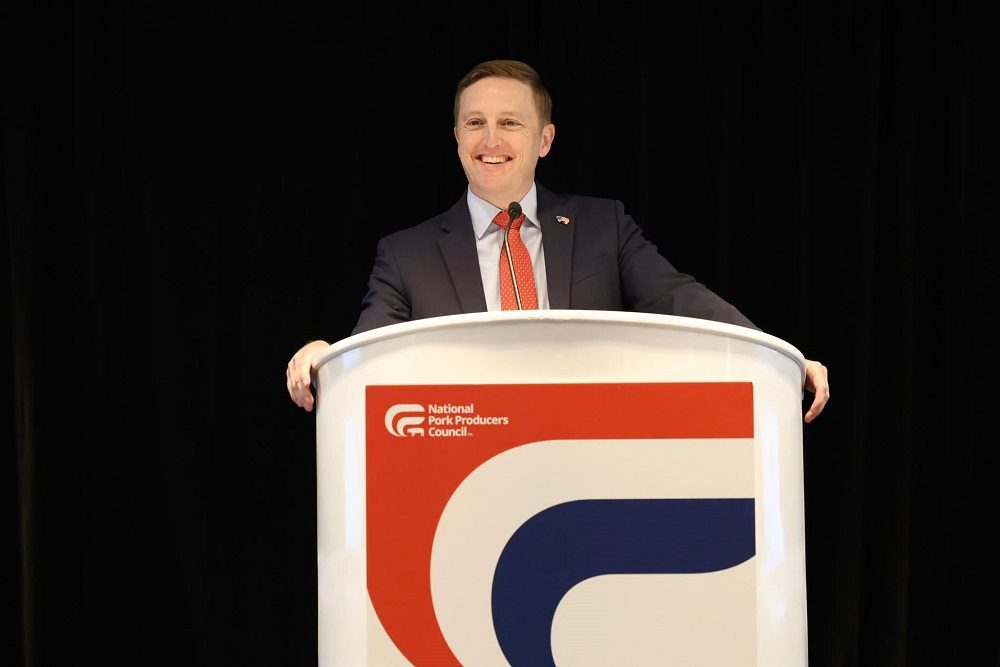
“America’s pork producers deserve a robust farm bill, which should come with protection from being forced to rebuild our barns every time another state decides it knows what is best for animal welfare,” said NPPC President Rob Brenneman, an Iowa pork producer.
Nearly 150 pork producers take the fight to Capitol Hill
The pressure campaign continued Thursday as nearly 150 pork producers from 24 states traveled to Washington, D.C., as part of the NPPC’s Legislative Action Conference.
The producers visited approximately 175 congressional offices, pushing lawmakers to include a federal solution to Proposition 12 in the final farm bill. Their agenda also included funding for the U.S. Swine Health Improvement Plan, year-round agricultural labor support and completion of the United States-Mexico-Canada Agreement review.
The timing was deliberate.
The Senate committee had just moved the farm bill forward, but an effort by Iowa Republican Sen. Joni Ernst to address state-by-state livestock production mandates did not make it into the committee legislation. Committee Chairman John Boozman ruled the amendment out of order after the amendment process had been completed, according to reporting on the committee proceedings.
Ernst subsequently said the final legislation still needs to address Proposition 12.
“The final Farm Bill must also include a long-term solution to Proposition 12 that protects livestock producers from a costly future patchwork of conflicting state mandates,” Ernst said after the committee vote.
Why pork producers are focused on Prop. 12
California voters approved Proposition 12, establishing minimum requirements for the housing of certain farm animals and placing requirements on pork, veal and egg products sold in the state.
The pork industry argues that the California law reaches far beyond California because producers elsewhere must account for the state’s requirements if they want access to the California market.
NPPC says that creates a broader concern: what happens if additional states enact their own production standards?
The organization represents more than 60,000 U.S. pork producers and contends that a growing collection of state-specific requirements could force producers to build or manage separate production systems for different markets.
For farmers making long-term investments in barns, breeding systems and other infrastructure, that uncertainty can become a significant business issue.
NPPC has characterized the potential result as a “patchwork” of state laws and is calling for a federal solution in the Farm Bill.
Veterinarians: Animal welfare cannot be reduced to one measurement
The pork industry is also framing the debate as a question of veterinary science.
Illinois veterinarians Bill Hollis, DVM, and Aaron Lower, DVM, argued in comments released by NPPC that animal welfare is more complicated than a single measurement such as the amount of space available to an animal.
“As veterinarians, we know that good welfare cannot be reduced to a single measurement such as square footage,” the veterinarians said.
Their concern is that rigid statutory requirements could make it harder for producers and veterinarians to adapt as scientific understanding of animal health and welfare changes.
NPPC says veterinary medicine is built around evaluating new evidence and continually improving production practices, while laws can be slower to change.
That argument is at the heart of the organization’s push for Congress to address Prop. 12 as part of the Farm Bill rather than allowing individual states to establish increasingly different production standards.
Farm Bill still faces major hurdles
The Senate committee vote gets the legislation to the full Senate, but it does not guarantee passage.
The committee advanced the bill 12-11, with Republicans voting for it and Democrats voting against it. The legislation now faces negotiations and the need to secure sufficient support on the Senate floor.
That leaves pork producers with a narrow window to push their priorities before the final Farm Bill is assembled.
NPPC is urging congressional Agriculture Committee leaders to produce a bipartisan bill that addresses the industry’s concerns about production costs, interstate commerce and animal-welfare requirements.
And for pork producers, the fight over Proposition 12 is far from over.
The Farm Bill may have cleared its latest congressional hurdle, but the industry’s push for a federal solution to the state-by-state livestock regulation issue is now headed into the next—and potentially more consequential—stage of negotiations.