

Indiana corn growers currently rolling combines through late-season fields or finishing up silage harvest are being urged to keep a close eye on the canopy. A mysterious, fast-spreading corn leaf spot disease—historically described as Maize White Spot or Phaeosphaeria leaf spot—has erupted across Michigan and the Great Lakes region, causing rapid leaf tissue damage and threatening yields in heavily affected fields.
First identified during the 2026 growing season across 14 Michigan counties, the outbreak has since exploded to at least 20 counties in Michigan, with parallel reports surfacing in Pennsylvania and New York. Now, suspected cases are officially landing on Indiana soil.
Dr. Darcy Telenko, Extension Field Crop Pathologist at Purdue University, tells Hoosier Ag Today that she has flagged similar symptoms in Indiana cornfields and recently dispatched diagnostic plant samples across state lines to Michigan State University’s field crop pathology laboratory for definitive confirmation.
A Mystery Pathogen on the Move
What makes this emerging threat particularly troubling for agronomists and plant pathologists is its elusive scientific identity.
“This is a pretty new disease for us,” explains Dr. Marty Chilvers, Field Crops Pathologist and Extension Specialist at Michigan State University. “As far as we can tell, this disease was reported in Florida back in 1999. We’re still working to confirm if it’s exactly the same disease or not—it’s producing similar symptoms, but part of the challenge is there’s not good reference material to go back and check with DNA or other features to make sure it is identical.”
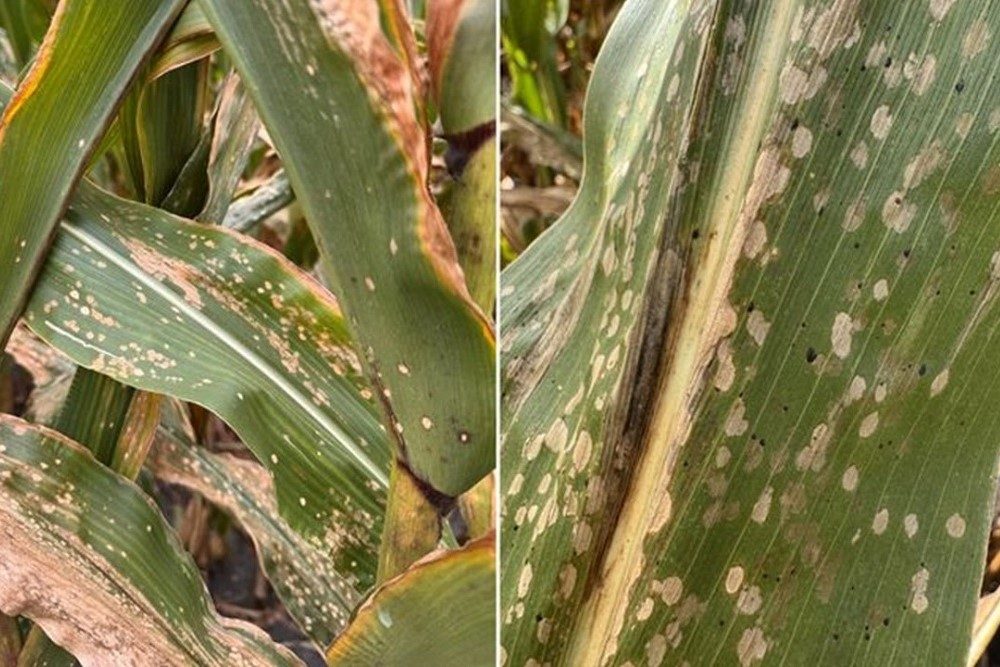
Under field magnification, symptomatic leaves reveal tiny black fruiting structures called pycnidia nested inside bleach-white lesions. While laboratory testing consistently isolates a phomoid fungus from these infected tissues, initial DNA sequencing has not yet provided sufficient genetic resolution to pin down the exact fungal species.
The sudden outbreak leaves researchers wrestling with a fundamental question: Is this a newly introduced pathogen, or a dormant disease that found perfect conditions in 2026?
“It’s possible that it was there lurking at low levels,” Chilvers notes. “Given how quickly it’s coming on and how severe it is in some situations, and how easy it is now to find in many fields, I think we would have seen it. It certainly may have been there a couple of years just sort of developing… if things are at a low level, they might be just hard to find in a field.”
Herbicide Lookalike Threatens Yields and Silage
For Hoosier farmers scouting fields prior to harvest, the physical appearance of Maize White Spot can be deceptively misleading. Lesions typically measure a quarter- to a half-inch wide and closely mimic contact herbicide drift, such as paraquat injury.
Because of this resemblance, early infections were easily overlooked or misdiagnosed as fertility deficiencies or chemical burn. However, in severely blighted fields, the biological impact is becoming painfully clear. The disease rapidly destroys green leaf area from the lower canopy all the way to the top leaves, triggering premature plant shutdown and accelerating drydown in corn silage.
“A few people mistook it for herbicide damage or some sort of fertility issue. It looks a lot like paraquat damage, and some of my agronomy colleagues are cautious, but they feel like there is some impact on corn grain yield. Some of the fields I’ve seen, I would be not surprised at all given the level of disease we’ve seen from top to the bottom of the plants—quite severely blighted with this disease,” says Chilvers.
The Next Frontier: Managing Inoculum for 2027
With harvest underway, immediate in-season chemical control is no longer an option for 2026 crops. Instead, pathology experts at Purdue and MSU are stressing the long-term risk: overwintering fungal inoculum.
Much like the early spread of tar spot across Indiana a decade ago, widespread late-season leaf infection leaves dense fungal residue on stalks and trash left in the field. This residue can easily survive Midwest winter conditions to infect subsequent corn crops next spring.
“The concern is, because it is so easy to find now—and I think I can pretty much find it in every field we walk into—that this will leave inoculum for next season. And that might see potentially, you know, some more damaging impacts on the 2027 crop. [That’s why] getting an accurate diagnosis is really important,” says Chilvers.
While heavy tillage is often suggested after severe disease outbreaks, Chilvers cautions Indiana farmers against making drastic operational changes before more research is completed.
“We have done long-term till/no-till work in other systems like tar spot, and essentially demonstrated that that can influence things, but it’s a pretty minor effect,” says Chilvers. “I would not encourage people to break out the moldboard plow. The amount of diesel you’ll spend in that is not going to translate into significant economic savings in terms of managing this disease.”
Instead, future defense will center on hybrid screening to identify resistant commercial corn genetics and establishing targeted fungicide application protocols.
What Indiana Farmers Should Do Right Now
Purdue Extension and MSU Extension are appealing directly to growers, crop consultants, and agronomists across Indiana to pull leaf samples from suspect fields before harvest equipment rolls through.
-
Scout Late-Season Fields: Inspect corn for distinct white or bleached lesions containing small black pinpoint spots inside the tissue.
-
Collect Representative Leaves: Gather fresh, actively developing symptomatic leaves. If samples cannot be shipped immediately, dry them flat inside a paper bag.
-
Submit to Diagnostic Clinics: Indiana growers should send samples immediately to the Purdue University Plant and Pest Diagnostic Clinic (PPDCL) in West Lafayette or contact Dr. Darcy Telenko. Michigan samples can be sent directly to MSU Diagnostic Services or Dr. Marty Chilvers.
“Getting an accurate diagnosis is really important, and if we can get samples in, then we can figure out where it’s been a problem in the Midwest,” Chilvers emphasizes. “That’ll be important going forward as we try to determine management plans and understand the impact of this.”
Send your images or the sample to the Purdue Plant Pest Diagnostic Lab.
Mail to: Plant and Pest Diagnostic Laboratory, LSPS-Room 116, Purdue University, 915 W. State Street, West Lafayette, Indiana 47907-2054.
The lab is operating and the building is open, but the lab door is remaining locked. If dropping off a sample is more convenient than shipping, please call or email the lab prior to stopping by: Phone: 765-494-7071; Email – ppdl-samples@purdue.edu.
If you have any question please contact Darcy Telenko (dtelenko@purdue.edu/764-496-5168) or PPDL (ppdl-samples@purdue.edu/765-494-7071).