


Indiana agriculture generates more than $35 billion in annual economic impact, leading the nation in duck, egg, turkey, pork, corn, and specialty crop production. Yet, out of the $27.5 billion Hoosier consumers spend on food each year, only a small fraction stays on the state’s family farms. At the same time, nearly one million Hoosiers living with diet-related chronic conditions struggle to access fresh, locally grown fruits, vegetables, and high-quality protein.
To close this gap, the Indiana State Department of Agriculture (ISDA) has released a comprehensive landmark report titled Making Indiana Healthy Again by Increasing Hoosier Access to Local Foods. Sparked by Governor Mike Braun’s Executive Order 25-58—part of a broader state initiative aligned with the national “Make America Healthy Again” movement—the study outlines a bold roadmap to rebuild the state’s middle-mile supply chain, streamline regulations, and turn local food access into an economic engine for rural communities.
Reclaiming the Local Food Dollar
For Indiana State Department of Agriculture Director Don Lamb, expanding local food networks isn’t about replacing the traditional commodity market that feeds the world; it’s about creating crucial high-value alternatives for local growers.
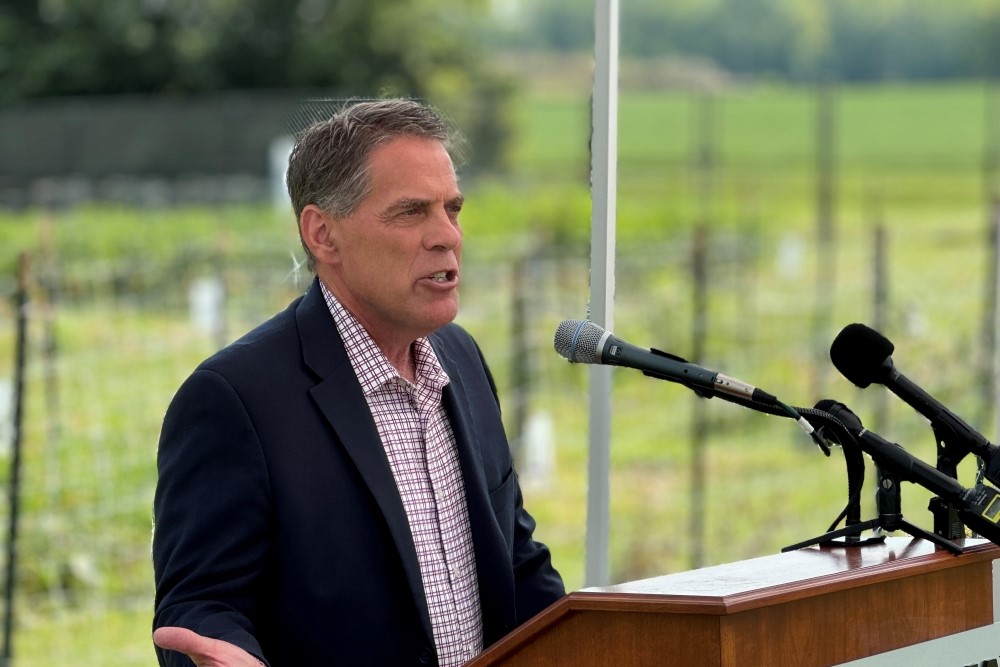
“I look at it as economic development opportunities, you know, if there’s a way that we can take a Hoosier ag product and sell it to a Hoosier, those dollars just churn in our state,” says ISDA Director Don Lamb. “And that’s always good if we can do things locally from an economic development perspective, that’s a good thing. We’ve got plenty of people that are raising food on what might be a fairly small scale, and they need to find ways to get it into the market in a more efficient manner—get it into a wholesale type market instead of just a farmers’ market.”
The report highlights a striking paradox: While 90% of Indiana grocery decision-makers recognize local foods and nearly two-thirds say local sourcing matters to them, price, availability, and convenience keep most shoppers tied to national supply chains. When farmers sell through conventional long supply chains, they retain an average of just 17.4 cents of every consumer dollar. By contrast, direct-to-consumer and short supply chain models—such as food hubs, farm stops, and regional wholesale partnerships—can return 75% to 85% of that revenue directly back to the producer.
Overcoming the “Middle-Mile” Bottlenecks
Moving food from an Indiana field or pasture to a Hoosier dinner table or school cafeteria sounds simple, but mid-sized producers face severe structural hurdles.
“So many times the barriers from getting it from the farm to the consumer are really the barriers to expanding that production,” Lamb notes. “And how can we help that? How can we make that better? And so the study really looked into lots of barriers, and then it looked into those opportunities, and then how do we marry those together?”
According to the ISDA report, the primary barriers limiting local expansion include:
-
Processing Deficits: Small and mid-sized livestock operations face irregular slaughter availability, while specialty crop growers lack regional facilities for light processing (such as washing, dicing, and packaging) required by institutional buyers.
-
Regulatory Patchworks: Indiana’s home-rule structure leaves retail food enforcement up to 92 individual county health departments, leading to inconsistent interpretations of food safety codes across county lines.
-
Capital Constraints: Upfront investments in cold storage, refrigerated transport, and processing equipment remain out of reach for expanding operations.
-
Institutional Barriers: Schools, hospitals, and state facilities struggle with contract rigidity and distributor dominance that favor out-of-state suppliers.
Director Lamb stresses that resolving these issues isn’t about loosening food safety standards, but making the regulatory landscape predictable and accessible.
“A lot of it has to do with access to capital, some of it has to do with the regulatory process—just being a daunting process,” Lamb explains. “And when I say that, you don’t want to make a regulatory process unsafe or easy or water it down. It’s got to be a very good regulatory process. But how do you make it to where everybody can understand the process, can afford to be a part of that process, and in making food safe?”
A Lifeline for Rural Communities and Health Outcomes
The push to expand local food pathways is vital for rural Hoosiers living in food deserts. Despite being surrounded by world-class farmland, many rural families lack access to fresh, nutrient-dense proteins, dairy, and produce.
The report identifies Food is Medicine (FIM) initiatives—including Produce Prescriptions (Rx) and Double Up SNAP programs—as high-impact strategies. Predictive modeling in the report indicates that fully scaling FIM programs across Indiana could drive $1.16 billion in annual healthcare spending, with $513.7 million circulating directly through the local food economy. This shift would generate more than $100.9 million in new farm revenue across 640 small- to mid-sized farms and create over 7,530 jobs in logistics, processing, and healthcare-aligned services.
Furthermore, the report reassures producers and consumers that Indiana’s existing commercial food system remains strong, safe, and world-class.
“We ought to be very proud of our food system. We’ve got an incredible food system,” Lamb emphasizes. “It’s not because we’re trying to break something that’s broken. We’ve got the most reliable, safe, affordable food system in the world. In this report, it’s not a replacement of a system… it’s an add-on, especially from an economic development perspective, to a system that’s already the best in the world.”
Actionable Next Steps: Funding the Future of Indiana Ag
To convert research into results, the ISDA report proposes concrete, state-level investments:
-
Agricultural Market Development Fund: Restructuring existing state research funds to create a flexible fund that can accept state appropriations and private investments to deliver matching equipment and technology grants to expanding agribusinesses.
-
Supercharging Indiana Grown: Expanding funding for the state’s signature marketing initiative—which currently operates with nearly 1,700 members across all 92 counties on a lean $250,000 annual budget—to boost buyer matchmaking, retail placement, and consumer awareness.
-
Indiana Butchery Training Program: Partnering with Purdue University’s Animal Sciences Department to train a skilled workforce for regional meat packing and processing.
-
Statewide Regulatory Consistency: Implementing mandatory state-led calibration and a neutral reciprocity process for county health departments to give food businesses uniform rules across county lines.
-
GIS Asset Mapping & Value Chain Coordination: Establishing a live GIS map of state processing, cold storage, and distribution assets while deploying dedicated specialists to connect farms with schools, hospitals, and grocery buyers.
Director Lamb points to targeted capital grants as the single most effective catalyst for farm growth.
“There are so many small operations that need a little boost to get to the next level,” says Lamb. “If I could just get to that next level, I need X piece of equipment and it costs $300,000, and I can’t afford that today. But if I had a grant that paid half that cost, I could do it, and then you would jump, and you really just accelerate that growth. If we can cut it to three years by offering a grant in a system that makes sense, that’s just a great case for everybody because it accelerates the local economy and accelerates tax dollars back into that local economy.”
Key Data Summary: Making Indiana Healthy Again Report
| Metric / Category | Data Point / Finding | Impact on Ag & Communities |
| Indiana Ag Output |
$35+ Billion total economic impact; 200,070 jobs supported. |
Core pillar of the state economy. |
| Hoosier Food Spending |
$27.5 Billion spent annually on food by Hoosiers. |
Massive opportunity to capture in-state market share. |
| Farmer Food Dollar Share |
17.4¢ retained in national supply chains vs. 75¢–85¢ in local food hubs. |
Direct local sales multiply farm profitability. |
| Consumer Sentiment |
63% value freshness; 55% value taste; 63% plan to buy more local. |
High consumer demand ready to be tapped. |
| Consumer Barriers |
51% cite higher price; 50% cite limited availability. |
Supply chain infrastructure must improve to lower costs. |
| Food is Medicine Impact |
$513.7 Million direct local ag circulation potential. |
Unlocks $100.9M in new farm revenue & 7,530 new jobs. |
| Indiana Grown Network |
1,700 members across 92 counties; 12% avg. revenue bump for logo use. |
Highly trusted brand needing state program funding expansion. |
The Path Ahead
The Making Indiana Healthy Again by Increasing Access to Local Foods study makes clear that expanding local food networks is a win-win strategy for the state. By investing in middle-mile infrastructure, streamlining county-level regulation, and connecting local farms to schools, hospitals, and rural grocers, Indiana can protect farm family livelihoods, boost rural main streets, and ensure every Hoosier has access to high-quality, locally grown food.