


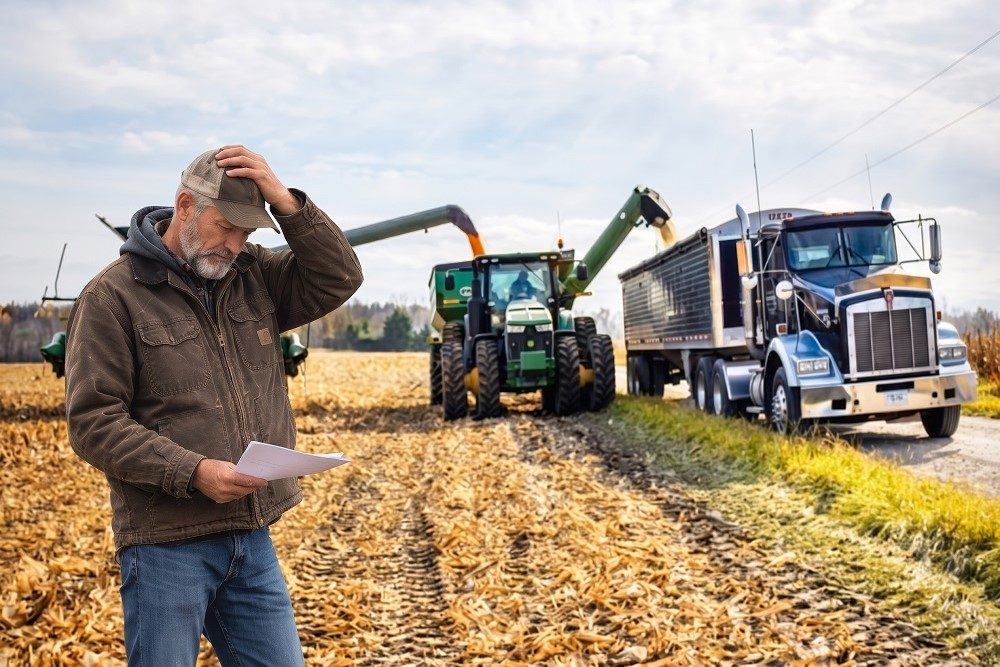
A stark financial warning light is flashing across the rural Midwestern landscape. Despite a modest uptick in overall producer sentiment this fall, a growing number of farmers say they are watching their financial safety nets erode at a rapid pace after years of persistent margin pressure.
According to the latest Purdue University/CME Group Ag Economy Barometer survey released Tuesday, November 3, the share of U.S. farmers reporting a “strong balance sheet” plunged to 62% in October—down sharply from 76% in January. That represents a 14-percentage-point slide in farm financial equity in just ten months.
In a companion question, 40% of survey respondents acknowledged they no longer maintain a solid working capital position heading into winter financing and 2027 crop planning.
Dr. Michael Langemeier, Director of the Purdue Center for Commercial Agriculture and co-author of the report, says the multi-year burn on farm liquidity is now showing up clearly in farm accounting ledgers across the country.
“That was a very large drop, essentially in just nine months,” Langemeier says. “What’s going on here is that tight margins are reducing liquidity. The pressure is particularly strong on the current side of the balance sheet. This is about the third or fourth year in a row of relatively tight margins, particularly for crop producers. When you see something like that, you just see a reduction in working capital, a reduction in liquidity, and that’s what we’re picking up.”
Working Capital Squeeze Forces Operational Trade-offs
The survey results paint a picture of an agricultural sector where operational flexibility is narrowing rapidly. While the Farm Capital Investment Index bumped up to 55 in October, only 20% of producers indicated that now is a good time to make major investments in machinery or farm buildings.
For producers holding current financial ratios near or below the critical 2-to-1 benchmark, cash flow constraints are dictating everyday management decisions heading into 2027.
“When you have really tight working capital, you have very limited flexibility,” Langemeier explains. “You have to be really cautious about how you spend the remaining liquidity that you have. What you really need to do is see if you can restructure some of your term loans, see if you can borrow against land that you own to try to free up some resources to pay term debt and to cover your expenses.”
Government Payouts Provide Temporary Cushion
Interestingly, the overall Ag Economy Barometer index actually edged up three points in October to 126, while the Index of Current Conditions jumped 16 points. However, Langemeier cautions that this temporary burst of autumn optimism was largely driven by the arrival of USDA Agriculture Risk Coverage (ARC-CO) and Price Loss Coverage (PLC) program checks in mid-October, rather than a fundamental turnaround in commodity markets.
“I think it really helped—and that’s putting it mildly,” Langemeier notes. “One of the reasons why the index of current conditions was actually up from September to October was the fact that we started receiving those payments in mid-October. It brightened people’s optimism a little bit because they saw those payments, and that helped stem the tide a bit on working capital. But we have to stop to think about why we got a payment: the reason we got a payment is that corn prices and soybean prices were not very strong for the 2025 crop.”
Who Is Bearing the Brunt?
While financial stress is spreading, the survey data and economic analysis indicate that the downturn is not falling evenly across rural America. Livestock producers have generally fared better over the past two seasons, while grain farmers—particularly two key demographics—are taking the brunt of the equity hit.
“Typically, when you see balance sheets looking weaker, it’s usually two categories of farms,” Langemeier says. “The first category is younger operators that do not own a lot of land or assets, so their debt-to-asset ratio is pretty high, making them very vulnerable to market shocks. The other vulnerable group consists of producers who don’t own much land for whatever reason and primarily rent most of the ground they farm. Land is extremely important in times like this because owning land on that balance sheet makes it so much stronger and allows you to withstand shocks.”
The Farmland Value Firewall
The critical question for Midwest agriculture is how long farm balance sheets can endure low commodity prices and elevated input costs before structural shifts—such as forced land sales, asset liquidations, or accelerated consolidation—take hold.
Both short-term and long-term farmland value expectation indices softened in October’s survey, but overall land values have remained remarkably resilient across the Corn Belt. According to Langemeier, that land equity acts as the ultimate firewall preventing a broader debt crisis.
“You could call that the million-dollar question, but I’ll call it the billion-dollar question because we have billions of dollars tied up in farmland in production agriculture in the U.S.,” Langemeier says. “As long as farmland values stay relatively steady where they’re at, balance sheets won’t get as weak as what they were in the 1980s. But if we saw some erosion in land values, then it’s a completely different ballgame. Then we’re looking at a crisis situation.”
For now, lenders and farm managers are advising producers to lock in crop inputs cautiously, review debt service structures early, and preserve remaining liquid cash buffers before entering the 2027 production cycle.
CLICK BELOW for Hoosier Ag Today’s radio news report: