

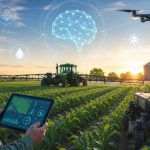
Artificial Intelligence is rapidly becoming part of the agricultural landscape, and experts say its impact on farming will only grow in the decades ahead.
From analyzing crop conditions and predicting yields to helping farmers make management decisions, AI is providing new tools to improve efficiency and productivity.
Associate Professor of Agricultural Economics at Purdue University, Dr. Trey Malone describes using AI on the farm with this metaphor, “So, you have a really good undergraduate intern in your pocket now, and you never trust the final product of the undergraduate intern. What you do trust is the beginning stages of the project to the undergraduate intern, and then you polish it from there. And so, I think that’s for anybody in ag and food right now, it’s thinking about what I would have hired an intern to do before and how can I use this to make this a larger task?”
While the technology continues to evolve, many producers are already using AI-powered systems to process large amounts of data in a fraction of the time it once required.
AI is also proving valuable beyond the field. Farmers, agribusiness professionals, and researchers are using it to simplify complex reports and technical documents.
Malone adds, “For anybody in ag and food right now, it’s thinking about what I would have hired an intern to do before and how can I use this to make this a larger task?”
Industry leaders emphasize that AI is not expected to replace trusted advisors such as agronomists, crop consultants, or extension specialists. Instead, it serves as another tool in the toolbox…helping producers find answers faster and make more informed decisions.
As technology continues to advance, AI appears poised to play an increasingly important role in the future of agriculture.