


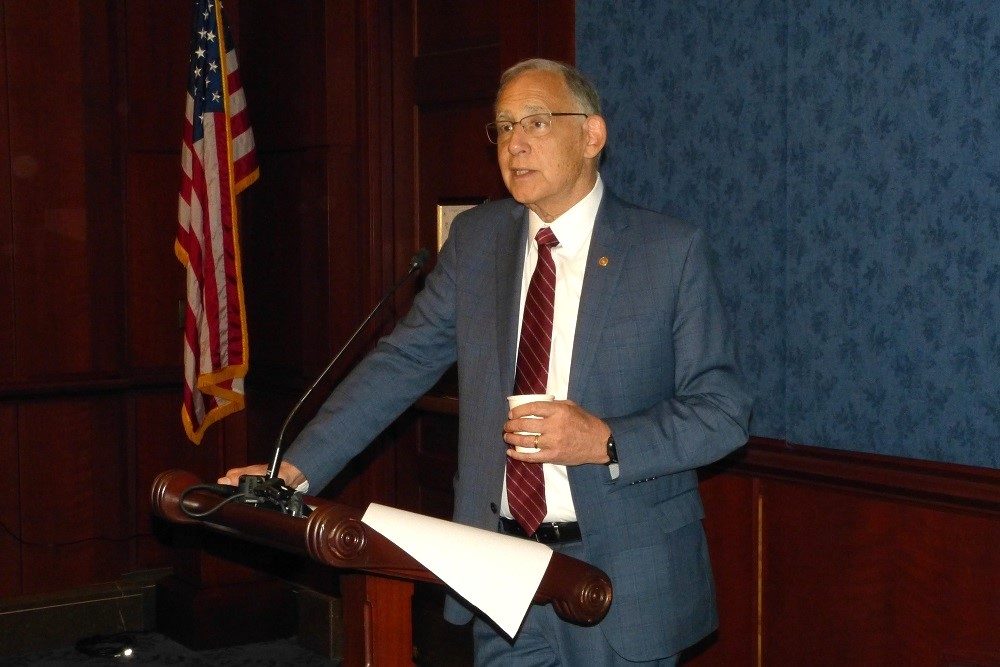
After years of delays, partisan gridlock and mounting frustration across farm country, Senate Agriculture Committee Chairman John Boozman on Tuesday unveiled a sweeping new proposal aimed at completing what many lawmakers and agricultural leaders have described as Congress’s unfinished business: passing a comprehensive farm bill.
The legislation, dubbed “Farm Bill 2.0” by Senate Republicans, represents the Senate’s latest attempt to modernize federal agricultural policy at a time when many producers are facing some of the most challenging economic conditions in decades. The proposal builds upon farm safety net investments approved last year through budget reconciliation legislation while seeking to address a broad range of issues affecting farmers, ranchers, foresters, rural communities and food systems.
Yet, the long-awaited text serves as a stark reminder of the fragile math governing a deeply divided chamber. In a notable concession to legislative reality, the draft omits a highly aggressive push by the commercial pork industry to overturn California’s animal welfare mandates—a calculation Boozman explicitly attributed to a lack of Democratic support.
“We can all agree that we must take steps to help America’s farm families, and one of the most important ways we demonstrate that commitment is by passing a bipartisan farm bill,” Boozman noted in a statement accompanying the draft.
The Pragmatism of Omission: The Prop 12 Dilemma
The omission of a federal “fix” for California’s Proposition 12—the state law establishing costly and burdensome housing standards for pigs—marks a significant tactical deviation from the Republican-led House, which included the measure in its own agricultural package in late April. The National Pork Producers Council (NPPC) has fiercely lobbied for federal intervention, warning that a patchwork of state-level mandates threatens to drown smaller family operations in compliance costs.
But in the Senate, where Republicans will need to secure at least nine Democratic votes to overcome an inevitable filibuster, ideological purity has taken a backseat to arithmetic. Boozman acknowledged that while he personally favors a restriction on state-level mandates, forcing a partisan show-vote yields zero structural benefits for the pork industry.
The NPPC says that it has led a coalition of over 330 agricultural groups pushing for the restriction of state-level production mandates like Prop 12. Despite this strong industry backing, Boozman emphasized that without shifting the political numbers in the Senate, the legislation could otherwise end up failing.
“We can have all the organizations in the world support it, as I do, but if you can’t find some Democrats to actually vote for it, it doesn’t work,” said Boozman.
The political calculations do not stop at livestock. Boozman pointed out that similar bipartisan realities forced the committee to leave out state-level SNAP nutrition exemptions and pesticide deregulation.
Strategic Realignment: Timelines and Supplemental Safeguards
Rather than treating the farm bill as a catch-all vehicle for immediate economic relief, Senate architects are splitting their priorities into distinct legislative tracks. To provide greater depth on how this proposal will actually navigate the legislative calendar, Boozman detailed a compressed timeline aimed at moving the text through committee before the late-summer recess.
“What we’d like to do is leave this out there for a couple weeks and then we’re going to come back after the two-week break, and during that period before August, work hard to actually have a vote and get it out of committee,” according to Boozman.
Concurrently, the chairman is looking outside the farm bill framework to address the immediate financial bleeding occurring on row-crop operations. Economists have warned of severe balance sheet degradation due to tight margins and elevated borrowing costs. Rather than overloading the permanent farm safety net, Boozman intends to pass direct, multi-billion-dollar emergency relief through an upcoming federal supplemental spending package.
“I think it’s vital that we have another bridge payment as soon as possible, I think the preferred place to put that is in a supplemental,” said Boozman. “The administration has just sent over how much they feel like they’re going to need for the military. I think along with that, you’ll see disaster relief… It won’t just be a military bill… and I think this bridge payment will be a big part of that, and I think it will ultimately help the whole package move.”
Expanding the Safety Net and Rural Infrastructure
For an agricultural sector operating under a framework designed nearly a decade ago, the broader “Farm Bill 2.0” text aims to build directly upon the $68 billion in safety-net funding established during 2025’s budget reconciliation package.
Beyond traditional crop insurance updates, the proposal aggressively targets structural deficiencies within rural communities. The draft includes permanent funding authorizations for rural broadband development, expanding rural childcare centers, and dedicating fresh federal capital to small-scale, regional meat processing facilities to circumvent the supply chain bottlenecks that have plagued the sector.
The Uphill Climb
The publication of this discussion draft formally ignites a high-stakes legislative sequence. Historically, passing a farm bill relies on a classic logrolling coalition: rural lawmakers seeking agricultural safety nets teaming up with urban lawmakers protective of domestic nutrition spending.
By adjusting elements of the Supplemental Nutrition Assistance Program (SNAP) and tightening foreign agricultural land-ownership disclosure requirements, Senate Republicans have laid down their opening marker. Whether these provisions can successfully court the necessary Democratic votes over the coming weeks remains the defining question for rural America’s economic stability.
Click HERE for the legislative text.
Click HERE for a title-by-title summary.
Click HERE for a section-by-section.
Click HERE for an overview.
CLICK BELOW for Hoosier Ag Today’s radio news report: