

A team of Purdue University scientists has uncovered a hidden genetic switch that could reshape the future of soybean production in the United States. By revealing—and ultimately controlling—the plant’s own biological “accelerator pedal” for nitrogen fixation, the researchers have opened the door to soybean varieties capable of producing more protein, higher yields, and stronger returns for American farmers while reducing dependence on expensive synthetic fertilizers.
The study, published this month in the Proceedings of the National Academy of Sciences, details an intricate internal communications network that allows soybeans to regulate their own nutrient intake. By using gene-editing technology to fine-tune this mechanism, researchers successfully boosted the plants’ defense against low-nitrogen environments, resulting in higher protein content and better seed quality.
The findings arrive at a critical moment for global agriculture, which faces the dual pressures of feeding a growing population and reducing the environmental footprint of synthetic fertilizers. Soybeans are a cornerstone of global food security; while they are a staple crop on their own, they also serve as the primary protein source for global livestock.
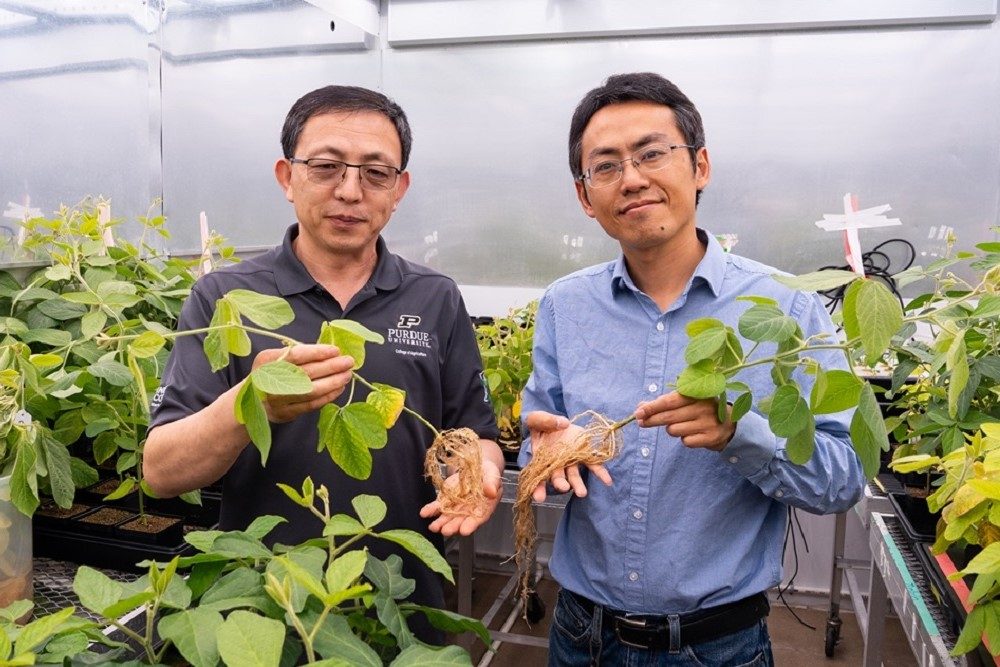
“Whether we eat meat or plants, nearly all protein that humans consume ultimately comes from plants,” said Jianxin Ma, a professor of agronomy at Purdue University who co-led the study.
Unlike many other crops, soybeans and other legumes have a natural evolutionary advantage: they can harvest their own nitrogen directly from the air. They do this by forming a symbiotic relationship with soil bacteria called rhizobia. The plant coaxes the bacteria into specialized root structures called nodules, where the microbes convert atmospheric nitrogen into a usable nutrient. In exchange, the plant feeds the bacteria sugars produced through photosynthesis.
However, this relationship is a delicate balancing act. Creating too many nodules drains the plant’s energy, while creating too few leaves the plant starved of nutrients.
Until now, scientists primarily understood the “brakes” of this system—the genetic pathways that prevent runaway nodule growth. The new study exposes the counter-mechanism: an elegant, long-distance relay system that accelerates nodule production when nitrogen levels in the soil drop.
“Signals are sent from leaves to roots and back again, communicating the situation and needs back and forth,” said Blake Meyers, a distinguished professor of plant sciences at the University of California, Davis, who co-led the research.
The relay begins in the roots, which produce a small chain of amino acids called a peptide. The plant pumps this peptide upward through its xylem—the internal plumbing system that transports water—to the leaves. Once there, the peptide triggers the production of a specific microRNA molecule. That microRNA then travels back down to the roots, where it silences a gene that would otherwise suppress nodule growth.
By applying gene-editing tools to hack this pathway, Ma and his team were able to optimize the process, essentially keeping the accelerator pressed to maximize nitrogen fixation.
When tested on a legacy research variety of soybean, the genetic modification yielded noticeable benefits, including enhanced seed quality and higher overall protein density. Because this specific genetic circuitry is shared by other major legumes—like the common bean—but absent in standard lab model plants, the discovery opens the door to transferring the technology to a wide variety of global food crops.
The breakthrough has already moved beyond the theoretical. Purdue University has filed a patent for the gene-editing technology, and agricultural companies have signed testing agreements to see if these benefits can be successfully replicated in the elite, high-yield soybean varieties used by commercial farmers today.
If successful in the field, the technology could complement traditional farming practices, such as coating seeds with beneficial bacteria before planting. More importantly, it offers a biological alternative to expensive, fossil-fuel-heavy synthetic nitrogen fertilizers.
“With these insights, we may be better able to optimize a natural process of nitrogen fixation,” Meyers said, “and reduce our dependency on expensive fertilizer.”