


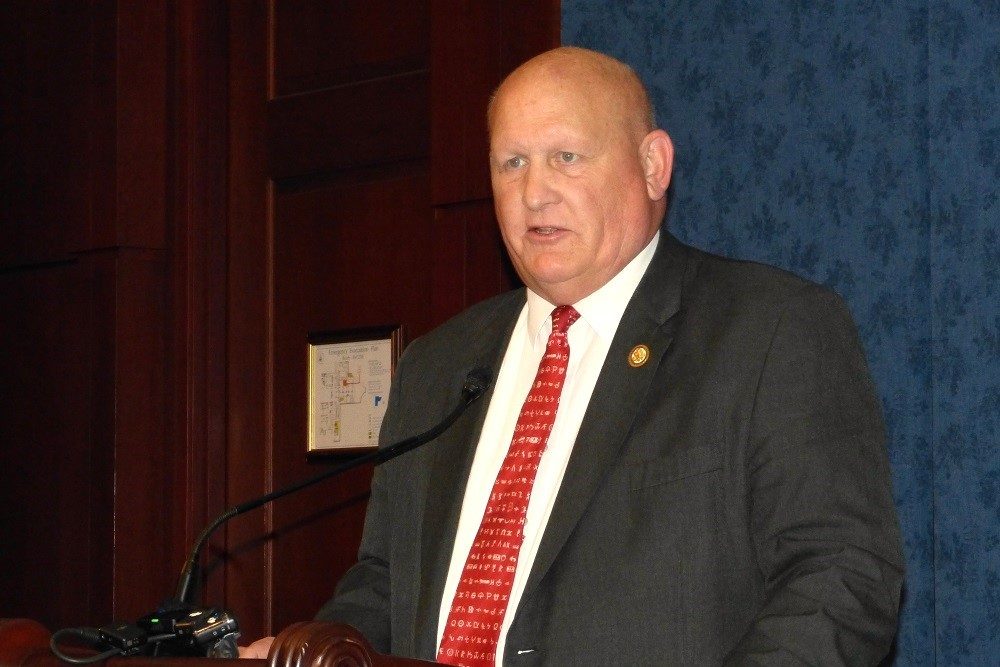
After years of relentless lobbying by America’s farm groups, House Agriculture Committee Chairman Glenn ‘GT’ Thompson (R-PA-15) unveiled sweeping legislation Tuesday to overhaul the nation’s agricultural guestworker system for the first time in four decades.
The proposal—already drawing strong public backing from more than 400 agricultural organizations that argue labor shortages threaten the nation’s food supply—would expand access to legal foreign workers, reduce regulatory burdens, and open the H-2A program to year-round livestock and dairy operations long excluded from the system.
The Securing Agriculture’s Workforce Act of 2026 (SAWA) represents the first major statutory reform to the H-2A temporary agricultural worker visa program since its creation four decades ago under the Immigration Reform and Control Act of 1986.
Faced with a dwindling domestic workforce, American farmers have grown increasingly dependent on foreign labor. Demand for H-2A visas has skyrocketed from fewer than 100,000 certified positions in 2013 to nearly 415,000 in 2025. Yet, the 40-year-old program has long been restricted to strictly “seasonal” and “temporary” work contracts of 10 months or less, legally shutting out year-round agricultural sectors like dairy, pork, and poultry.
The new bill directly addresses these limitations by eliminating the “seasonal” mandate, allowing temporary workers to remain on the job under contracts lasting up to 350 days. It also expands eligibility to include controlled environment agriculture, forestry, aquaculture, and livestock operations.
“There is no greater national security threat than disruptions to our food supply,” Chairman Thompson said in a statement. “The Securing Agriculture’s Workforce Act of 2026 makes the practical, commonsense reforms required to prevent these disruptions by providing a workforce that meets agriculture’s needs—now and in the future.”
The legislation arrives amid intense pressure from a coalition of more than 400 agricultural organizations, representing sectors from fruit growers to livestock producers, who have lobbied intensely for federal relief.
American Farm Bureau Federation (AFBF) President Zippy Duvall emphasized that the severe lack of domestic applicants left producers with few alternatives.
“The lack of available labor is among the largest limiting factors of American agriculture,” Duvall said. “Most Americans don’t want to work on farms. In fact, only 182 domestic applications were submitted for nearly 415,000 advertised positions in 2025. If Americans won’t apply for these jobs, we have no other choice but to depend on the H-2A program.”
Duvall added that the bill “delivers meaningful farm labor reform and will provide certainty and fairness to both farmers and their employees as they contribute to a strong and healthy food supply.”
For the dairy sector, which operates 365 days a year, the bill marks a historic shift. Gregg Doud, president and CEO of the National Milk Producers Federation (NMPF), hailed the legislation as a game-changer for producers who have been entirely excluded from the guestworker pool.
“The Securing Agriculture’s Workforce Act represents the most significant reform to the ag workforce we’ve seen in decades,” Doud said. “It is particularly critical for dairy farmers, who have been effectively shut out of the nation’s primary legal agricultural guestworker program. First and foremost, this bill finally grants dairy access to H-2A by removing the seasonal requirements of the program and allowing contracts up to 350 days of the year.”
Beyond expanding access, the bill contains a provision that is bound to trigger sharp debate among immigration hardliners and labor groups: a mechanism allowing existing, unauthorized agricultural workers to transition legally into the H-2A program. To participate, workers must pass background checks and an in-person interview. The bill does not provide a pathway to citizenship, maintaining the H-2A program’s non-immigrant status.
The pork industry also strongly endorsed the changes. Rob Brenneman, a pork producer from Washington County, Iowa, and president of the National Pork Producers Council (NPPC), noted that workforce shortages have hampered pork production over the last five years despite competitive wages.
“Agriculture needs a strong—and reliable—workforce,” Brenneman said. “For pork producers, one giant step in the right direction means expanding the H-2A visa program to include year-round agricultural industries like ours. Thank you, Chairman Thompson, for listening to our ideas and solutions for rectifying our severe workforce shortage.”
In addition to expanding access, the bill targets the soaring compliance costs that have frustrated farmers. Between 2010 and 2025, the government-mandated Adverse Effect Wage Rate (AEWR)—the minimum wage farmers must pay H-2A workers—outpaced general inflation by over 70%.
SAWA aims to control these costs by codifying a 2025 court-ordered interim methodology that utilizes Bureau of Labor Statistics data, capping annual wage rate fluctuations to a maximum 3.5% increase or a 1.5% decrease. It also establishes a standard daily housing adjustment, allowing farmers to deduct a fair cost for the free housing they are federally required to provide.
To reduce bureaucratic gridlock across the Departments of Labor, Homeland Security, and State, the bill mandates the creation of a centralized, online portal for all employer and agency interactions. It also allows for multi-year labor certifications and housing inspections.
The inclusion of agricultural cooperatives is another key economic driver built into the text, clarifying that co-ops can apply for visas on behalf of their members to lower individual administrative hurdles.
“For too long, farmers with year-round labor needs have been locked out of the H-2A program through no fault of their own, and farmer co-ops have faced legal uncertainty about whether they can use the program to serve their members,” said Duane Simpson, president and CEO of the National Council of Farmer Cooperatives (NCFC). “SAWA fixes both of those problems… We urge Congress to move swiftly to pass SAWA and give America’s farmers and their cooperatives the tools they need to get the job done.”