


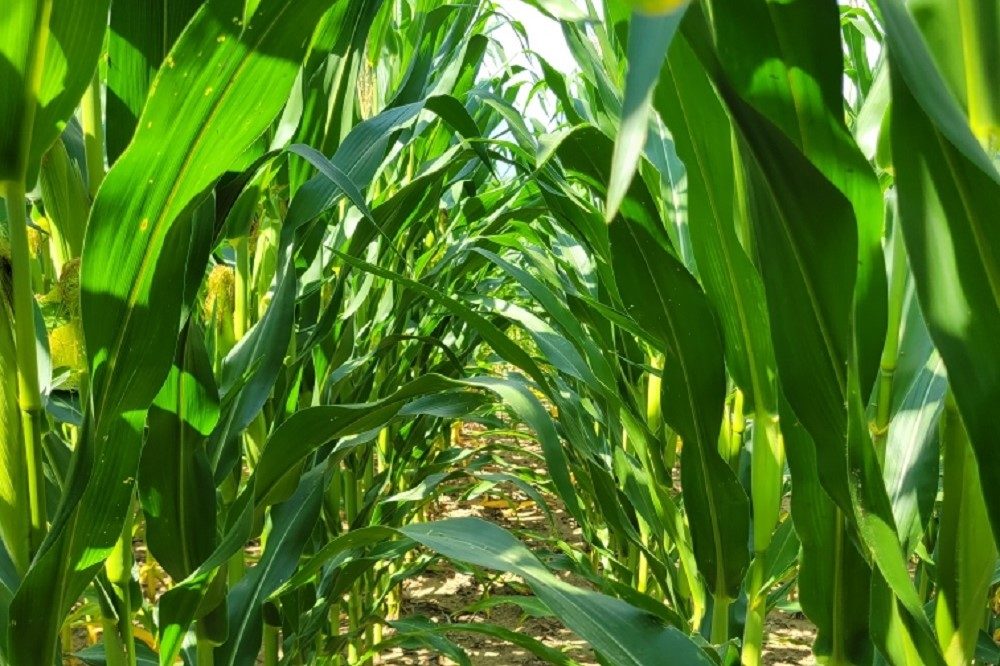
American corn farmers grew a historic, record-shattering crop last year, anchoring an industrial economic engine that drives $142 billion in total economic activity across the United States, according to a comprehensive study released this month by the National Corn Growers Association (NCGA).
The report, which tracks the deep supply chain linkages of the nation’s largest crop, arrives at a critical crossroad for the agricultural sector. While the 2025 harvest was massive in volume, a resulting supply glut has dragged grain prices well below historical averages, pinching farm margins even as rural spending buoys hundreds of non-farming industries.
“The nation’s corn growers drive economic activity far beyond their farms, supporting local communities and boosting the broader U.S. economic engine,” said Gretchen Kuck, an economist for the NCGA and author of the study.
According to the analysis, which utilizes regional economic modeling software from IMPLAN, every single bushel of corn harvested in the U.S. last year generated an associated $8.34 in secondary economic activity as it rippled through the broader economy.
Breaking Records on the Ground
On the farm, the sheer scale of the 2025 harvest was unprecedented. Ideal growing conditions and advanced agronomics helped U.S. farmers pull a staggering 17.02 billion bushels of corn out of the ground—a 14% increase over the prior year’s already substantial crop. The harvest was cultivated across 98.8 million acres, marking the highest planted acreage seen in the United States since 1933.
Yields also reached an all-time high of 186.5 bushels per acre. The direct market value of the crop itself reached an estimated $70.1 billion, up from $64.7 billion the year prior.
The Economic Splash Damage
The NCGA study breaks down the macro-impact of the corn crop into three distinct economic tiers:
-
Direct Effects ($73.4B Output): The baseline economic activity occurring directly at the farm level, which directly employs more than 156,000 workers and contributes $16.8 billion to U.S. gross domestic product (GDP).
-
Indirect Effects ($41.4B Output): The upstream supply chain. Corn farmers rely heavily on outside vendors, indirectly impacting 489 different industries by purchasing billions in fertilizer, machinery, fuel, financial services, and transportation.
-
Induced Effects ($27.0B Output): The localized retail ripple. Farm hands, equipment dealers, and chemical manufacturers spend their wages at local businesses, filtering money into rural healthcare systems, restaurants, and real estate.
In total, the industry supported 482,293 American jobs in 2025, yielding $32 billion in wages and contributing $56 billion to total U.S. GDP.
Broad Industrial Reach
While the heart of the economic activity remains concentrated in America’s agricultural sectors, the study emphasizes how deeply corn production is woven into urban and technical corporate supply lines.
Of the 20 broad industry groups classified by the North American Industry Classification System (NAICS), 17 saw an economic boost exceeding $1 billion due to corn production.
Outside of agriculture itself—which claimed $79.0 billion in output—wholesale trade giants captured $9.8 billion in economic activity, while the real estate and leasing sector logged $8.8 billion. Commercial manufacturing hauled in $7.7 billion, while finance and insurance companies backed $5.6 billion in related business. Even service-oriented sectors like healthcare ($4.5 billion) and food services ($2.2 billion) saw measurable lifts from localized farm spending.
State-Level Dominance
Geographically, the benefits of the bumper crop stretched into all 50 states, though the traditional Midwestern “Corn Belt” captured the lion’s share of the wealth.
Iowa led the nation, with its $11.4 billion crop translating into $19.7 billion in total state economic output and supporting nearly 49,000 jobs. Illinois followed closely behind, turning a $9.8 billion crop into $18.5 billion in total economic activity and supporting a nation-leading 56,501 jobs. Other massive agricultural footprints included Nebraska ($13.9 billion in output) and Minnesota ($12.3 billion in output).
Meanwhile, Indiana showed a $4.6 billion corn crop, $8.1 billion in total state economic output, and more than 30,000 jobs supported.
Michigan had a $1.37 billion corn crop, a total state economic output of $4.5 billion, and nearly 14,000 jobs were supported by corn production throughout the state.
Yet, even states with nominal or zero direct grain production saw millions of dollars in induced economic activity due to corporate banking, transport infrastructure, and technical supply chains. California, which grew only $40.7 million worth of corn, pulled in a massive $4.7 billion in overall economic output and supported nearly 20,000 jobs through these indirect linkages.
A Financial Paradox for Growers
Despite the celebratory tone of the macroeconomic data, the report highlights an unsettling reality for the roughly 500,000 American farmers who grow corn: big crops do not always equate to big profits.
The sheer volume of the historic 2025 harvest created a massive domestic supply buffer, pushing prices downward. The season-average price received at the farm gate for the crop plummeted to an estimated $4.15 per bushel.
To put that in perspective, the current price is significantly lower than the five-year average of $5.10, the 10-year average of $4.31, and the 20-year average of $4.32.
“The study points to the major contributions of corn growers as these farmers face mounting input costs and low corn prices,” the NCGA noted in its summary.
For many growers, the $4.15 per bushel price tag hovers perilously close to, or below, the break-even cost of production, which has been driven higher in recent years by stubborn inflation across equipment, land rent, and petroleum-based fertilizers.
While the broader American economy continues to reap the secondary rewards of cheap, abundant grain and the massive industrial spending required to produce it, America’s farmers are absorbing the financial bruises of their own record-breaking productivity.
CLICK HERE to read the full study.