

The economic shockwaves radiating from a tense Middle East are quietly rewriting the math of American agriculture, driving up the cost of growing the nation’s food and raising fresh alarms in Washington over national and food security.
According to a sweeping new white paper released by the American Farm Bureau Federation (AFBF), recent military conflicts involving Iran and subsequent disruptions in critical trade corridors like the Strait of Hormuz have triggered an immediate and punishing spike in essential crop inputs.
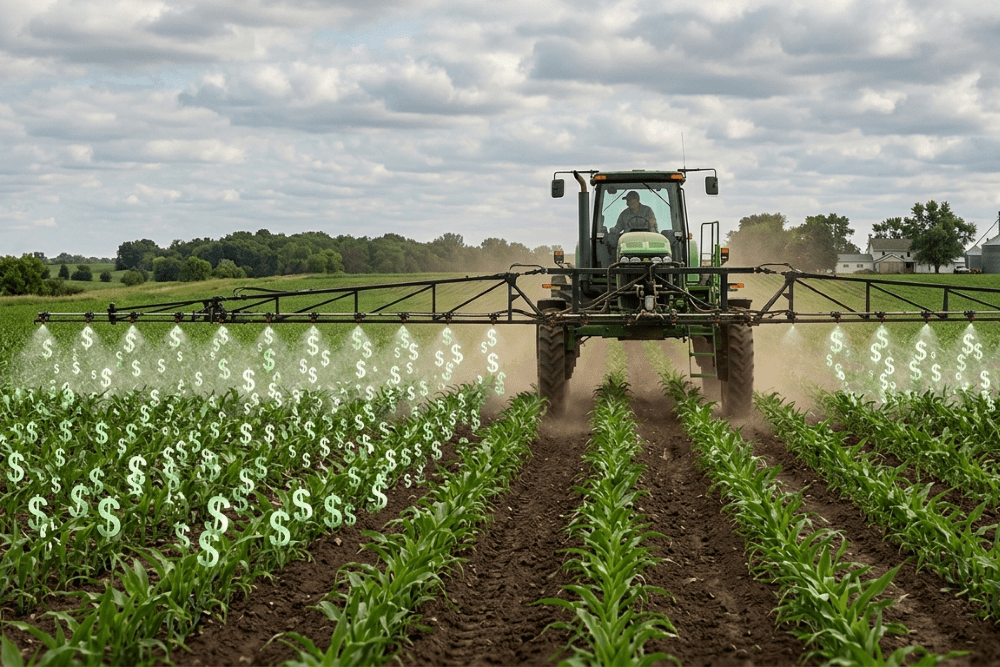
Following the latest geopolitical flashpoints, the U.S. Department of Agriculture (USDA) quietly revised its projected production costs for corn up to nearly $936 per acre—a 2% jump driven primarily by an 11% surge in fertilizer prices and a staggering 34% hike in fuel, lube, and electricity expenses. Across the agricultural sector, the pain is widespread: rice producers are absorbing an average cost increase of $75 per acre, while sorghum growers face the steepest fuel-cost escalations in the nation.
The fallout is no longer confined to the farm gate. Economists note that these compounding input shocks have fueled a broader inflationary pulse, pushing the Bureau of Labor Statistics’ Consumer Price Index up 2.5% over a three-month window—one of the sharpest sustained climbs since the chaotic post-Ukraine supply shocks of 2022.
A Fragile Web: The Global Fertilizer Trap
The core of the crisis lies in a stark structural reality: while the United States maintains robust domestic output for nitrogen, it remains profoundly vulnerable across other vital nutrients. The nation imports more than 95% of its potash—largely from Canada—leaving little margin for error when northern supply chains or rail networks hit turbulence. Meanwhile, domestic phosphate production capacity continues to tighten, forcing a heavier reliance on volatile import markets.
Global rivals are watching closely and acting aggressively. The white paper highlights how major competitors like China have weaponized their own reserves. As Middle Eastern supply lines fractured this spring, Beijing swiftly moved to ban key fertilizer exports to prioritize its domestic harvest, even as American and European farmers scrambled to secure supplies for narrow spring planting windows.
India, facing similar import dependencies, responded by orchestrating a massive government-backed buying coalition and injecting billions in additional subsidies to shield its agricultural sector from a 40% surge in global fertilizer costs.
By contrast, American producers find themselves exposed to international price swings without a coordinated federal buffer. While European natural gas prices soared past $14.80 per MMBtu following the latest Persian Gulf disruptions, domestic U.S. markets offered some relief via Henry Hub prices hovering near $2.94. However, because fertilizer is priced on a deeply interconnected global market, American farmers remain entirely unprotected from international energy shocks and maritime bottlenecks.
The Push for a U.S. ‘Strategic Fertilizer Reserve’
The mounting volatility has reignited high-stakes debates in Washington over government intervention. Policymakers are increasingly weighing the feasibility of a Strategic Fertilizer Reserve—modeled after the historic Strategic Petroleum Reserve established in 1975.
Proponents argue that a federal reserve could act as an indispensable emergency backstop, stabilizing prices during acute geopolitical crises and dampening the panic-driven purchasing that exacerbates market crunches. They point to the 2021 coordinated release of global oil reserves, which sent crude prices tumbling within days purely on the psychological strength of government signaling.
Yet, skeptics and agricultural economists warn of steep hurdles. Unlike crude oil, fertilizer products degrade over time, demand highly specialized and costly storage infrastructure, and encompass a complex array of distinct chemical formulations that are not easily interchangeable. Critics also caution that multi-billion-dollar government procurement programs risk distorting global markets, inflating prices before a single pound of fertilizer is ever deployed, and potentially favoring massive, vertically integrated agribusiness conglomerates over independent cooperatives.
A Race Against Time
The White House and Congress have begun laying the groundwork for long-term domestic resilience. In late 2025, the administration added phosphate and potash to the U.S. Geological Survey’s Critical Minerals List, while the USDA has worked to restart stalled production grants expected to eventually unlock over 2 million tons of annual capacity. On Capitol Hill, the discussion draft of the Agricultural Act of 2026 includes provisions to expand farm storage loan eligibility, establish dedicated crop-input economists, and streamline cumbersome federal permitting processes that can delay new manufacturing plants for years.
However, industry leaders emphasize that long-term fixes will take years to materialize, leaving growers exposed to the next global headline.
As geopolitical tensions simmer and input costs hover near historic highs, the central question facing lawmakers is no longer whether American agriculture is vulnerable—it is whether Washington can build a resilient defense before the next crisis hits the nation’s breadbasket.