


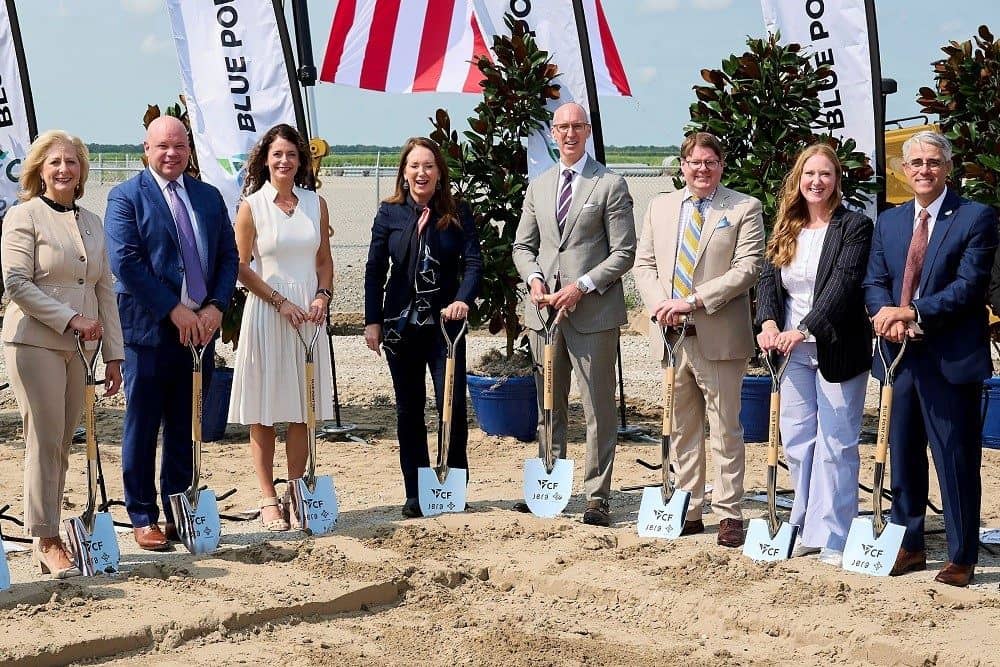
For farmers staring down another planting season of fertilizer prices, supply uncertainty and geopolitical risk, a groundbreaking ceremony along the Mississippi River in Louisiana may offer a glimpse of a very different future.
Blue Point One, a $3.7 billion ammonia production project in Modeste, Louisiana, officially broke ground Aug. 26. When it begins production in 2029, the facility is expected to produce 1.4 million metric tons of ammonia annually, making it the world’s largest ammonia plant.
For farmers in Indiana, Michigan and throughout the Corn Belt, the significance goes well beyond Louisiana.
The project could add a major new source of domestically produced nitrogen to a fertilizer supply chain that already relies heavily on imports and on an intricate network of pipelines, barges, railroads and trucks to move fertilizer from the Gulf Coast into the nation’s agricultural heartland.
U.S. Agriculture Secretary Brooke Rollins called the groundbreaking another major step toward greater fertilizer independence.
“Together, we take the latest, and perhaps the greatest at least, step so far, in moving back toward American fertilizer independence,” said Rollins.
A Gulf Coast project with Corn Belt implications
Blue Point One is a joint venture between CF Industries, Japan’s JERA and Mitsui. CF Industries owns 40% of the project, with JERA holding 35% and Mitsui 25%.
CF Industries is investing $3.7 billion in the project, with an additional $550 million planned over four years for shared infrastructure that will support ammonia production, storage, vessel loading and potential future fertilizer expansion.
That location is important.
The Gulf Coast is already a critical gateway for fertilizer moving into the interior United States. USDA’s fertilizer transportation data shows that fertilizer generally moves north from the Gulf Coast into the Corn Belt, often by barge, while ammonia also moves through a roughly 2,000-mile pipeline system connecting south Louisiana production and marine terminals with 25 delivery points, most of them in the Corn Belt.
In other words, Blue Point One isn’t being built in an isolated corner of the country.
It is being built at the front door of one of America’s most important fertilizer transportation networks.
Why that matters to Indiana
Indiana farmers already depend on fertilizer moving through that Gulf Coast-to-Corn Belt supply chain.
Indiana transportation data notes that ammonia-based fertilizers are imported through New Orleans and transported north by barge on the Mississippi River, while other fertilizer inputs reach Indiana through interconnected rail, barge and truck networks.
That makes additional Louisiana production potentially significant for Hoosier growers.
More domestic ammonia production in the Gulf could give fertilizer suppliers another source of nitrogen that can be moved north through existing infrastructure. That doesn’t mean every ton produced at Blue Point One will wind up in Indiana, nor does it guarantee lower fertilizer prices.
But it does mean more domestic supply entering a distribution system already designed to move Gulf Coast fertilizer into Indiana and the broader Corn Belt.
And that distinction matters.
A farmer doesn’t necessarily need the ammonia to be produced in Indiana to benefit from domestic production. What matters is the total supply available to the North American fertilizer market and how efficiently that supply can reach farm country.
Michigan could benefit through the same network
Michigan growers also stand to benefit from greater nitrogen supply resilience, although transportation routes will vary depending on the fertilizer product, supplier and farm location.
Michigan farmers use anhydrous ammonia as a nitrogen source, and the Michigan Department of Agriculture and Rural Development describes it as a readily available, lower-cost form of nitrogen fertilizer.
The broader Great Lakes and Corn Belt fertilizer markets are connected through rail, water and other transportation networks. USDA data shows fertilizer moving north from the Gulf can reach destinations throughout the Upper Mississippi, Illinois and Ohio River systems, while smaller volumes reach the Great Lakes.
That means the impact of a new Louisiana production facility could ripple well beyond the states immediately surrounding the Mississippi River.
The Mississippi River is the connection
The geography is particularly important for Corn Belt agriculture.
Grain typically moves south toward the Gulf for export. Fertilizer often makes the reverse journey.
USDA reports that in 2023, 11.7 million tons of fertilizer excluding ammonia originated around New Orleans and moved north, with shipments reaching the Upper Mississippi, Ohio River, Illinois River and other inland waterways.
The same transportation system that helps Indiana, Illinois, Iowa and other Corn Belt states move grain toward export markets can help bring fertilizer north toward those same farming regions.
For producers, that creates a powerful connection: the nation’s agricultural highway can move fertilizer toward the farm just as it moves corn and soybeans toward the global market.
A response to years of fertilizer uncertainty
Nitrogen fertilizer has become a strategic concern for American agriculture.
Global fertilizer markets have been repeatedly disrupted by wars, trade restrictions, energy prices, production outages and changing export policies. The result has been periods of sharp price increases and uncertainty for farmers trying to lock in fertilizer ahead of planting.
Deputy Agriculture Secretary Stephen Vaden said farmers have heard promises about domestic fertilizer production before.
Now, he argues, construction is finally beginning.
“That skepticism’s time has ended because action is now being taken. Fertilizer is going to be produced in this country,” said Vaden.
The project is particularly significant because ammonia is the foundation for many nitrogen fertilizers used by farmers. USDA notes that anhydrous ammonia is not only a fertilizer itself but also the precursor for nitrogen-based fertilizers.
So the impact of Blue Point One potentially extends beyond anhydrous ammonia.
Additional ammonia production can provide feedstock for products such as urea and UAN, depending on how the supply chain and future infrastructure develop.
The scale is difficult to ignore
The numbers behind Blue Point One are enormous.
The facility is expected to produce 1.4 million metric tons of ammonia every year—enough, according to Rollins, to support approximately 6.7 million acres of U.S. corn production.
CF Industries says the project will create more than 100 permanent manufacturing jobs once operational, while an estimated 3,900 construction jobs will be created over four years.
The project also includes more than $400 million in investment from Linde for an on-site air-separation unit supplying oxygen and nitrogen.
Blue Point One will use autothermal reforming technology and is designed to capture and permanently sequester approximately 98% of the carbon dioxide generated during production, according to CF Industries.
That low-carbon design could also position the facility to serve emerging ammonia markets beyond agriculture.
Don’t expect an immediate fertilizer price drop
For farmers, however, there is an important caveat. Blue Point One won’t produce its first ammonia until 2029.
That means the project cannot solve today’s fertilizer price or availability problems. Farmers will continue to face global nitrogen market forces over the next several years.
And even once Blue Point One is operating, additional domestic production does not guarantee fertilizer prices will fall.
Natural gas costs, global demand, international production, transportation expenses, tariffs, weather, inventories and the cost of moving fertilizer from Louisiana to individual farm markets will continue to influence what farmers pay.
CF Industries itself has warned that global nitrogen supply and demand could remain tight, with new production capacity not necessarily keeping pace with demand growth over the next several years.
But Blue Point One represents something perhaps more important over the long term: additional capacity.
A hedge against the next global disruption
That capacity could become increasingly valuable the next time a major fertilizer-producing region is disrupted.
The United States will still participate in the global fertilizer market. Farmers will still depend on imports of some nutrients and fertilizer products.
But every additional ton of ammonia produced domestically can reduce the degree to which American agriculture depends on production decisions made halfway around the world.
For Indiana and Michigan farmers—and growers across the Corn Belt—that is the real promise of Blue Point One.
The plant isn’t sitting next door to the farm.
It doesn’t have to.
It is being built beside one of the nation’s most important fertilizer transportation corridors, with direct access to the infrastructure that already moves fertilizer north into the heart of American agriculture.
And when the first ammonia rolls out of Blue Point One in 2029, the effects could travel hundreds of miles upstream—potentially all the way to the fertilizer tanks and applicators of America’s Corn Belt farms.
CLICK BELOW for Hoosier Ag Today’s radio news report: