

Indiana farmland values are holding steady this year, but what does the long-term outlook look like?
“We think of land as the residual claimant to whatever happens in the ag sector. So, when things are going really well, land really benefits,” says Todd Keuthe, the Schrader Endowed Chair in Farmland Economics at Purdue and author of the Purdue Farmland Values and Cash Rent Survey.
He explains why they track farmland values so closely.
“It’s essentially 82% of the assets. So, for every dollar of assets that a farmer owns, we expect about 82 cents of that to be in cash rent—82% to 83%. It’s also a non-trivial portion of our debt, currently about 65% according to USDA. That’s what they’re forecasting for this year. That’s been increasing over the last five to six years. We’ve seen farmers invest in land more heavily.”
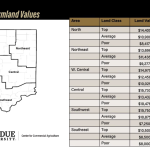
Statewide, top-quality Indiana farmland averaged $14,909 per acre in 2026 (a slight increase), while average-quality land was a little over $12,000, down about 1%. Poor quality land fell 3.1% to just under $9,500. But regional results varied considerably.
Purdue Center for Commercial Agriculture director Michael Langemeier joins Keuthe for a conversation about the survey as they discuss what their expectations are for 2027 values.
“If things move in three percent down to three percent up, that’s pretty stable,” Langemeier said. “I think that’s probably where we’re going to stay here for the foreseeable future. I don’t see those drivers either popping up substantially or popping down substantially.
“I would be really surprised by any movement up or down by more than 3% at the state level,” Keuthe added. “Honestly, I could convince myself that positive is more likely than negative, or negative is more likely than positive. I think it’s really cliche to say like a coin flip.”