


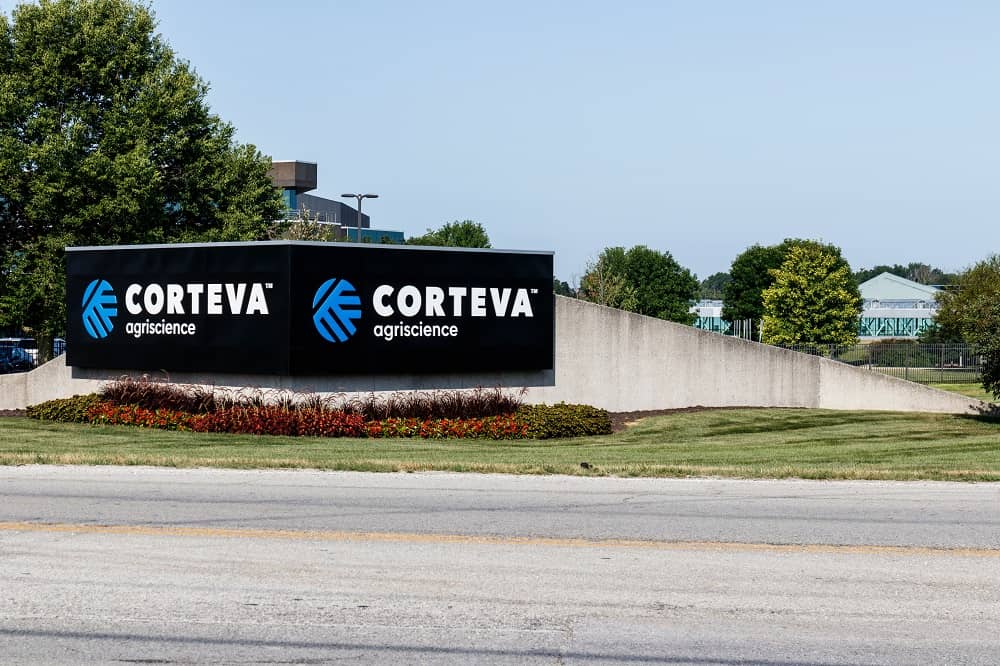
Corteva is pushing back against an effort by California and 20 other state attorneys general to stop the Indianapolis-based agriculture company from completing its planned separation into two independent companies.
With the Oct. 1 separation approaching, Corteva says the states are attempting to block a legitimate business transaction based on “speculative and unproven” PFAS claims—even though none of the states seeking the injunction has a judgment against Corteva, and no PFAS liability trials involving the company are currently scheduled.
For Corteva, the issue is straightforward: two businesses with different markets and business models are being separated so each can focus more aggressively on innovation, investment and growth.
The company says it will fight to complete that separation.
Corteva rejects the premise of the states’ case
In a Sept. 15 statement, Corteva “categorically rejects” the states’ attempt to stop the transaction.
The company says the legal challenge relies on novel theories and assumptions about liabilities that have not been established against Corteva.
Corteva also points to a key distinction between its current business and the historical chemical operations at the center of the states’ allegations.
During its seven years as an independent public company, Corteva says it has never made, sold or traded PFOA or PFOS products.
The company says its balance sheet will be capable of covering any liability it might ultimately face.
Corteva Chief Legal Officer Jennifer Johnson says there is no basis for characterizing the separation as an effort to evade creditors.
“Corteva neither has nor has demonstrated any intent to hinder, delay, or defraud our creditors,” Johnson said.
The company says the states are seeking extraordinary relief that would effectively prevent Corteva’s board and management from executing a corporate strategy approved after years of planning.
A strategic split—not an escape from liabilities
Corteva’s planned separation divides its agriculture operations into two focused companies.
The crop protection business will retain the Corteva name and remain headquartered in Indianapolis.
The seed and genetics business will become Vylor Inc., headquartered in Johnston, Iowa.
Corteva says the two businesses have fundamentally different business models and will be better positioned to serve farmers separately.
“As we’ve stated from the beginning, our planned separation is an acknowledgement that our two businesses have different business models and will better deliver for farmers separately than they do together,” Johnson said.
For Corteva, that means sharper strategic focus and greater flexibility to invest in technologies tailored to each business.
The crop protection company will concentrate on herbicides, fungicides, insecticides and biological and nature-inspired solutions as farmers face growing weed, insect and disease pressures.
Vylor will focus on seed genetics and biotechnology, launching with more than 4,000 germplasm patents and more than 2,000 biotechnology patents and a pipeline that includes gene editing, disease-resistant corn, hybrid wheat and next-generation biofuels.
States challenge the transaction over PFAS
California Attorney General Rob Bonta and the coalition of states and municipalities have asked a federal court in South Carolina for a temporary restraining order and preliminary injunction blocking the separation.
The states argue that approximately $39 billion in assets and value would move into Vylor, reducing the resources remaining with Corteva to address potential PFAS-related claims.
California alleges the restructuring is part of a broader pattern involving companies descended from the historic DuPont organization and argues that the transaction could make it more difficult to recover money for environmental contamination.
Corteva disputes that characterization and stresses that the allegations remain allegations.
There are no judgments against Corteva in the PFAS matters cited by the states, the company says, and no trials are scheduled against Corteva concerning PFAS liability.
That is a central point in Corteva’s argument that the requested injunction is unwarranted.
Indianapolis remains Corteva’s home
Whatever happens with the litigation, Corteva has made clear that Indianapolis will remain central to its future.
The company plans to keep its global headquarters in Indiana, along with its core research and development operations.
Roughly 2,000 Corteva employees work in Indiana, including approximately 1,500 at the company’s Indianapolis headquarters.
Corteva has pointed to Indiana’s deep agbioscience talent and research ecosystem as a critical advantage for its crop protection business.
Vylor’s headquarters will move to Iowa, creating two separate corporate centers for the two businesses.
Corteva says farmers need innovation—not uncertainty
Corteva argues that the stakes of the legal fight extend beyond corporate structure and shareholders.
Farmers are dealing with increasingly difficult weed, disease and insect pressures, and the company says continued investment in crop protection innovation is critical to protecting yields and food security.
The planned separation, Corteva says, is designed to give its crop protection business the freedom and focus to pursue that mission while allowing Vylor to concentrate on the next generation of seed genetics and biotechnology.
“Companies need flexibility to engage in transactions like this to continue to innovate and generate value for their customers and shareholders,” Johnson said.
The states are asking the court to freeze the transaction before it occurs.
Corteva is asking the court to allow its board-approved strategy to proceed.
With the planned Oct. 1 separation now only weeks away, a federal court will decide whether the company’s carefully structured breakup can move forward.
For Corteva, the message is unequivocal: the company says it is not running from its obligations—it is building two agriculture businesses designed to compete, innovate and serve farmers more effectively.