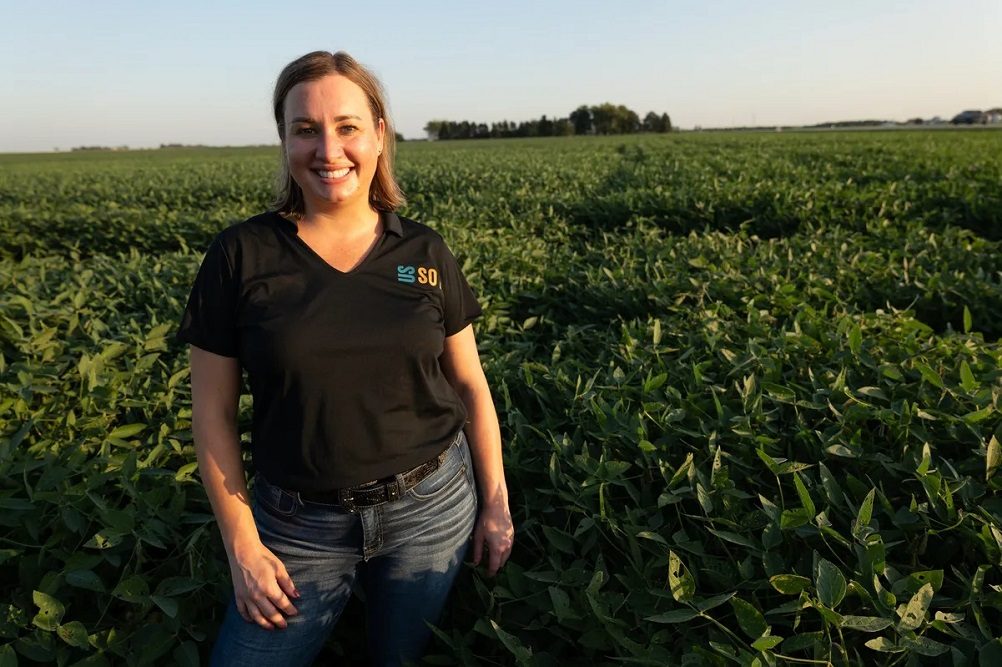

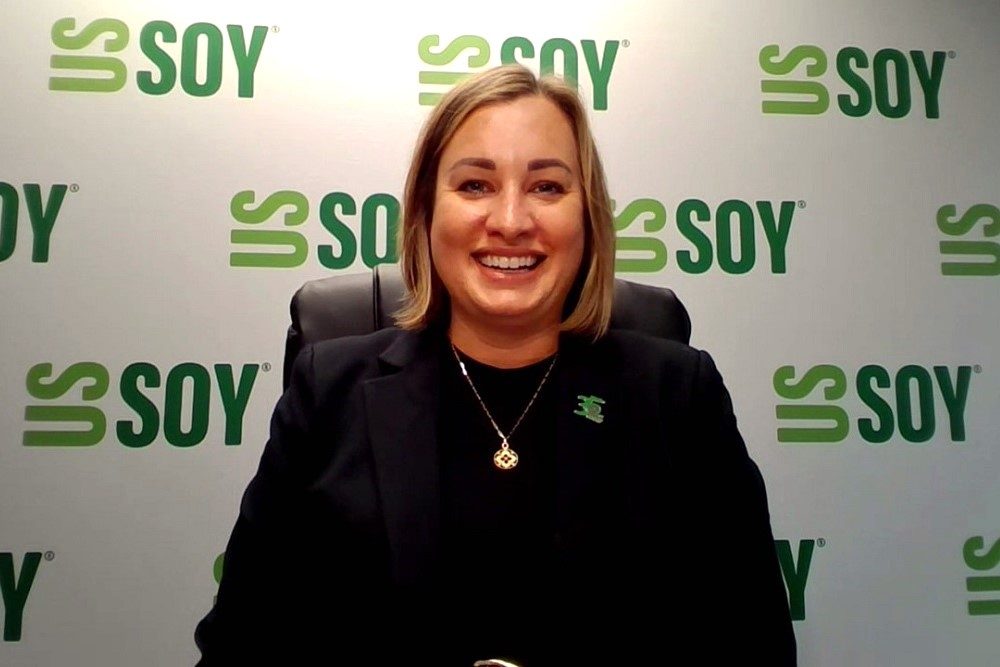
As soybean growers across Indiana and the Midwest navigate tight margins, elevated input costs, and hardening international trade friction, the United Soybean Board (USB) has officially ushered in new leadership. Courtney Knupp—a seasoned ag policy executive and former White House national security aide—officially stepped into her role as Chief Executive Officer of the USB on Oct. 1.
While Knupp’s recent resume includes coordinating federal food supply chain resilience at the National Security Council and advising leadership at the USDA, her strategic approach to agribusiness was forged right here in the Hoosier State.
A Proven Hoosier Foundation
Knupp spent pivotal years living and working in Indiana. Her professional footprint across the state includes commercial livestock marketing with Indiana-based Elanco Animal Health, directing animal nutrition meal strategy for the U.S. Soybean Export Council (USSEC) in Indianapolis, and serving as Vice President of International Market Development for the National Pork Board. During her tenure in Indiana, she also graduated as part of Class 15 of the Indiana Agricultural Leadership Program (ALP) through AgrIInstitute.
For Knupp, those years in Indiana proved fundamental to her view of agricultural economies and local-to-global policy execution.
“Indiana taught me a lot,” Knupp said. “You guys have a robust agricultural network full of great people… that enabled us to look at all aspects of rural economies to agriculture—soy, other crops—and understand the people and of which how we work at the local, state, and federal level to really make things happen. So, Indiana, I will say, really raised me… and it’s a joy to continue to do so with your state organizations.”
Knupp pointed directly to the strong, collaborative synergy between national checkoff investments and state-level initiatives led by organizations like the Indiana Soybean Alliance.
“Indiana has such a strong state soybean organization with great leadership… and we have many Indiana farmers that represent Indiana in soy at large at these national organizations, including United Soybean Board. So, we’re really fortunate for that.”
Confronting South American Headwinds
Knupp takes leadership as the Soy Checkoff marks its 35th anniversary—a milestone she views not as a historical milestone, but as an immediate call to action.
“Day one, it’s an exciting time to celebrate the Soy Checkoff’s 35th anniversary, and that really tells the story of the checkoff and why checkoffs are so valuable to farmers,” Knupp noted. “We’ve used your money—when you decided to stand this organization up—to shape the markets that exist today through decades of investment. How can we help farmers be more effective and have more tools in their toolbox by having well-researched, scientifically sound options for them to use on their farm?”
Top among her challenges is stiff international competition. Rapidly expanding production in Brazil, Argentina, and Paraguay has squeezed margins for Midwest row-crop producers, requiring a sharp focus on proving the distinct quality of U.S. soybeans.
“The Soy industry and all farmers are facing a lot of headwinds. We have tight margins, we have supply chain volatility, we have higher input costs, we have more competition both domestically and internationally. Our neighbors in South America in Brazil and Argentina bring a very serious game and we have got to prove the differentiation of U.S. soy—of which we definitely have—to our customers here and globally.”
To differentiate U.S. soy on the international market, USB is leaning into component quality rather than bulk volume alone.
“We know that we win on amino acids, digestibility, and other factors that make us more favorable when included in livestock rations to bring an ROI to our customers whether it’s here in the United States or abroad,” Knupp explained.
Expanding Domestic Industrial Markets
Beyond raw commodity exports and meal rations, USB continues to fund research to expand innovative domestic uses. From bio-based concrete sealants like PoreShield to high-oleic soybean oils, footwear, and bio-fuels like biodiesel and sustainable aviation fuel, expanding soy’s industrial footprint is essential to driving long-term value.
Knupp emphasized that maintaining a diverse portfolio of market opportunities gives American producers the resilience needed to weather volatile economic cycles.
“I don’t think I can choose just one, and that’s not how farmers win,” Knupp stressed. “We have to have diversified market opportunities because there will be so many things that ebb and flow that aren’t in our control that affect markets. We want to maximize soy’s position through sound research, science, and educating our farmers.”
As she assumes full leadership over the checkoff’s national budget, Knupp’s mission remains anchored in delivering measurable results back to individual farm gates across Indiana and the nation.
CLICK BELOW for Hoosier Ag Today’s radio news report: